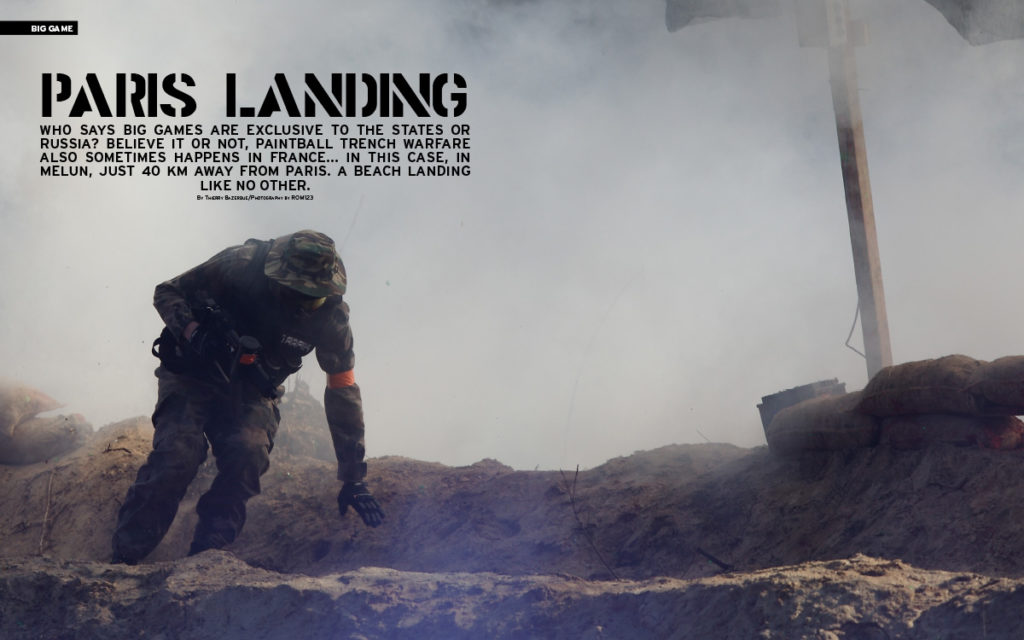
Who says Big Games are exclusive to the States or Russia? Believe it or not, paintball trench warfare also sometimes happens in France… in this case, in Melun, just 40 km away from Paris. A beach landing like no other.
By Thierry Bazerque/Photography by ROM123
The site was called FDP, and those crazy organizers managed to recreate a life-sized landing. For this event, more than 200 players were expected. When we got to the site at 9 AM, about fifty players were already there. Jean-Noël Péché (FDP organizer) had told us about this site and kept us in the loop as it was being built. We were all as excited as 12 year old kids, all trying to imagine what this field was going to be like. There were going to be four landing boats, trenches, bunkers… the game of a lifetime. But as we got out of our cars, we realized how wrong we had been. This site was unreal, so much better than in our wild expectations. On a gentle slope 360 feet long, 4 boats were set down on the sand, facing a well-protected beach, including 3 concrete bunkers overlooking the landscape.
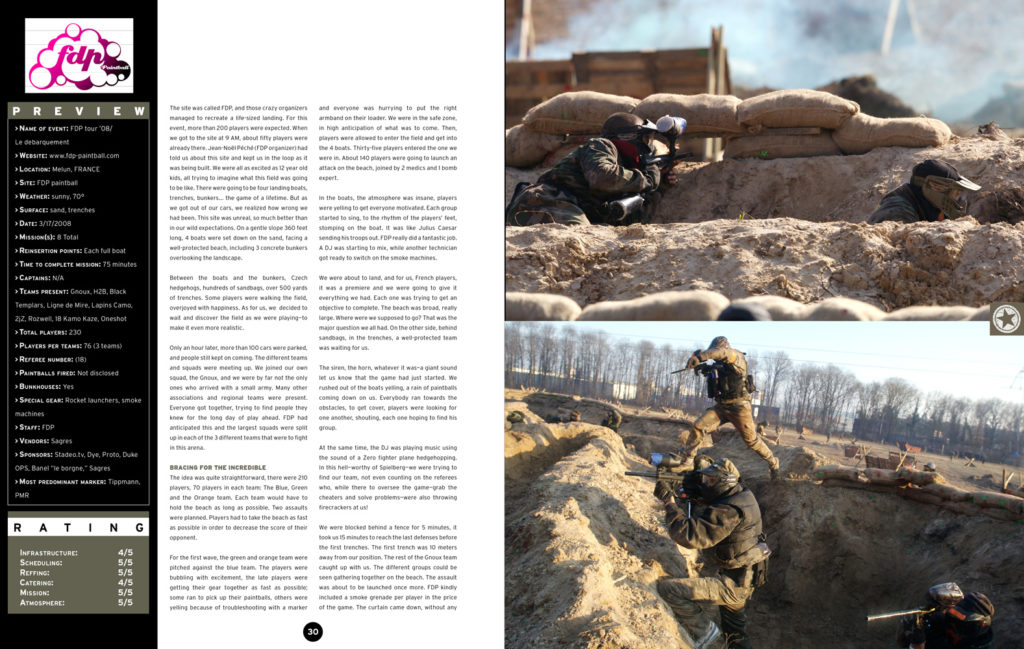
Between the boats and the bunkers, Czech hedgehogs, hundreds of sandbags, over 500 yards of trenches. Some players were walking the field, overjoyed with happiness. As for us, we decided to wait and discover the field as we were playing—to make it even more realistic.


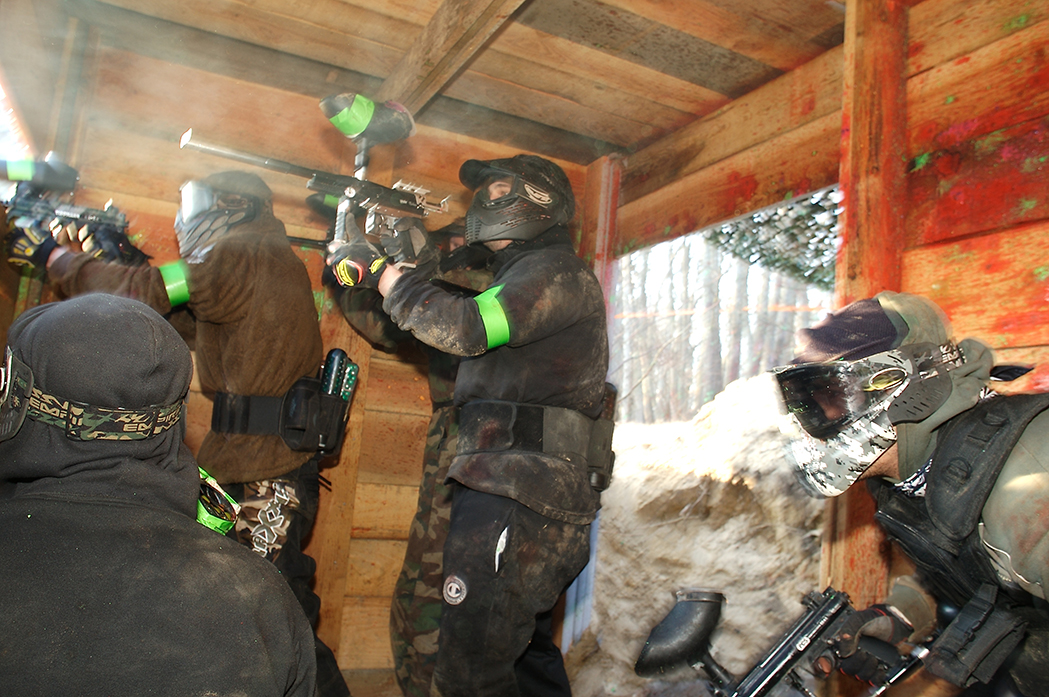


Only an hour later, more than 100 cars were parked, and people still kept on coming. The different teams and squads were meeting up. We joined our own squad, the Gnoux, and we were by far not the only ones who arrived with a small army. Many other associations and regional teams were present. Everyone got together, trying to find people they knew for the long day of play ahead. FDP had anticipated this and the largest squads were split up in each of the 3 different teams that were to fight in this arena.
BRACING FOR THE INCREDIBLE
The idea was quite straightforward, there were 210 players, 70 players in each team: The Blue, Green and the Orange team. Each team would have to hold the beach as long as possible. Two assaults were planned. Players had to take the beach as fast as possible in order to decrease the score of their opponent.
For the first wave, the green and orange team were pitched against the blue team. The players were bubbling with excitement, the late players were getting their gear together as fast as possible; some ran to pick up their paintballs, others were yelling because of troubleshooting with a marker and everyone was hurrying to put the right armband on their loader. We were in the safe zone, in high anticipation of what was to come. Then, players were allowed to enter the field and get into the 4 boats. Thirty-five players entered the one we were in. About 140 players were going to launch an attack on the beach, joined by 2 medics and 1 bomb expert.
In the boats, the atmosphere was insane, players were yelling to get everyone motivated. Each group started to sing, to the rhythm of the players’ feet, stomping on the boat. It was like Julius Caesar sending his troops out. FDP really did a fantastic job. A DJ was starting to mix, while another technician got ready to switch on the smoke machines.
We were about to land, and for us, French players, it was a premiere and we were going to give it everything we had. Each one was trying to get an objective to complete. The beach was broad, really large. Where were we supposed to go? That was the major question we all had. On the other side, behind sandbags, in the trenches, a well-protected team was waiting for us.


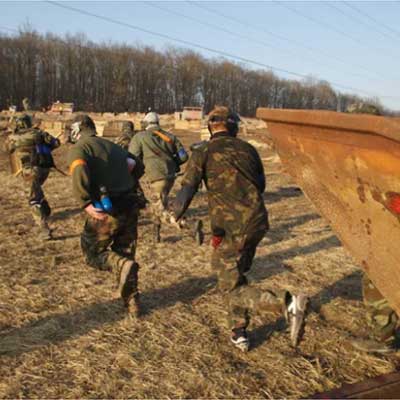
The siren, the horn, whatever it was—a giant sound let us know that the game had just started. We rushed out of the boats yelling, a rain of paintballs coming down on us. Everybody ran towards the obstacles, to get cover, players were looking for one another, shouting, each one hoping to find his group.
At the same time, the DJ was playing music using the sound of a Zero fighter plane hedgehopping. In this hell—worthy of Spielberg—we were trying to find our team, not even counting on the referees who, while there to oversee the game—grab the cheaters and solve problems—were also throwing firecrackers at us!
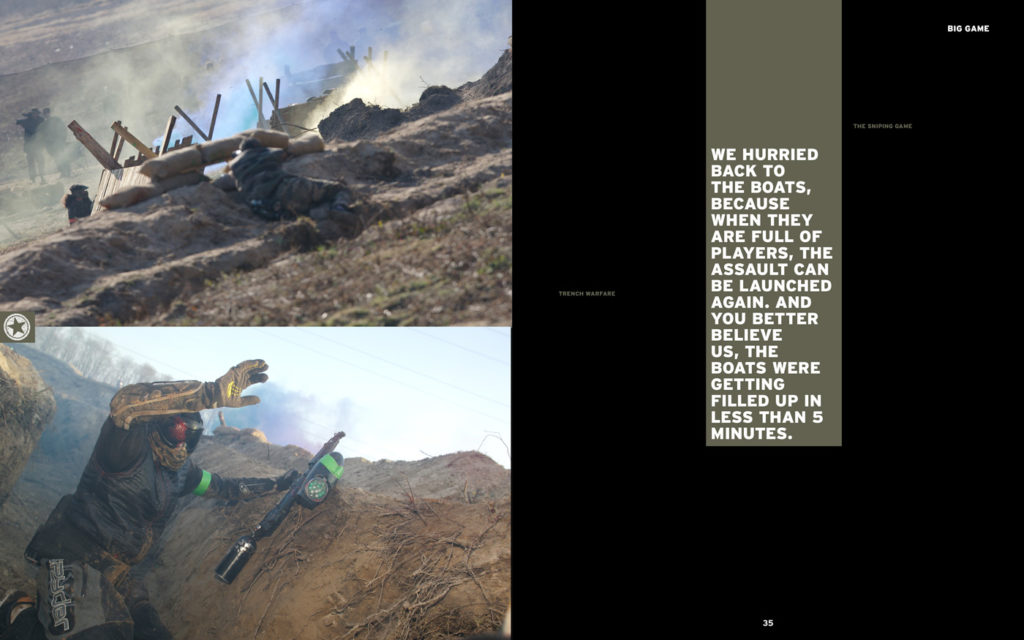
We were blocked behind a fence for 5 minutes, it took us 15 minutes to reach the last defenses before the first trenches. The first trench was 10 meters away from our position. The rest of the Gnoux team caught up with us. The different groups could be seen gathering together on the beach. The assault was about to be launched once more. FDP kindly included a smoke grenade per player in the price of the game. The curtain came down, without any coordination, players threw their smoke grenades to stop the opponents from seeing them. We didn’t go much further than the smoke screen, no sooner had we jumped in the first trench that we got out.We hurried back to the boats, because when they are full of players, the assault can be launched again. And you better believe us, the boats were getting filled up in less than 5 minutes.
Controlling the first trench took more time than expected, 3 assaults. But we rushed back as often as we could and we were never alone. But in the trenches, it was quite another story. Sometimes, the trenches were man-sized, sometimes hardly even 5 feet, and that was considerably stressful. You shouldn’t try to look up at anything, or that’s a hit right between the eyes.
The danger came from everywhere, you had to keep track of what happened before and beside you—in short, playing alone was a quick one way ticket to the safe zone.
TRENCH WARFARE
In the trenches, it was kind of like Verdun, each centimeter taken was characterized by heavy losses. Our opponents controlled the path, but we were gradually fighting up to the bunkers. It took us more than 20 minutes to reach the first bunker. And then the opposing team was pushed back. Once we forced their defenses we were just pushing them away. Victory was ours. The orange team had taken the beach.
But it was midday and the game stopped for the lunch break. Everyone gathered around, talking about the battles just lived and giving their overall feelings about the entirely revamped site. As for what happened to us, two things stood out in the game: the excitement when rushing out of the boats against incoming fire, and the uneasiness of making our way through the trenches.
After this first game, we took the time to recon the field. The bunkers were awesome, not a single nail could be seen out of the buildings, and the trenches, in spite of the violent assault, were still in good shape. Surprisingly, the same thing could be said about the sandbags. The quality of this field was really impressive. Facing the boats, I could imagine what our opponents had seen: 140 warriors running towards their barricaded positions. I couldn’t wait to be part of the defending team to get their experience. Just one hour later, it was time for another attack. The first game let everyone know about the strong and weak sides of the field. Our attack plan was clearly on the left and right flanks. But how could we stand united playing on a field 360 feet wide. You could only hope that a player could see his mate jumping in the first trench. This second game was more fluid than the first one. We were focusing our attention on the flanks, the Squads were playing with smaller teams and even walk-on players, who really enjoyed following us during this assault.
3 PM. The last attack was being prepared. There we were in the trenches to defend our base. This was an intense moment, seeing the attackers getting into the boats, just in front of us. We put down our marker, just to look at the scenery. Players were yelling, we were planning on a defense line where everyone had to take care of his teammate. A mobile group would alternate between the two flanks that had to be protected.
THE SNIPING GAME
To make sure we hit a player that landed, we waited for him to run for about 30 feet. We took our position in our trench and picked them off. There was an eagerness to take the fight to them one last time. The game-on alarm sounded. It was amazing to see them run towards our defenses, shooting anywhere and everywhere. Now we understood what the first defense team must have felt like. We had to stop a huge wave from crushing into our position, and stopping them from reaching our last defense line on the beach before they got into our trenches was our main objective. You constantly have to switch with your teammate, when he is done shooting and has to reload, it is your turn to shoot at the incoming players. There is a 30-second window without covering fire. We tried to stand our ground. We had noticed that during the two other games: fighting back meant a sure loss. This wasn’t going to happen to us. This way, we held the trenches for 20 minutes before the first line was taken. And then we were done. We tried to contain them into the first trench, where it’s much harder to duck down. We held the bunkers another 10 minutes before being flunked out of the beach into the forest and surrendering.
We were really disappointed. Not because we lost, but because it was the last game on this impressive field, worthy of a movie set. About 400 square feet of pure action, 1000 sandbags, 500 meters of trenches, about twenty referees, a DJ, smoke machines, and players who were really fair play. Everything that makes up good scenario paintball in France was there, from great equipment to great weather.


But the party wasn’t over, and this unforgettable day ended with loads of gifts. Dye offered a PMR marker as well as other smaller presents.
For a long time, France has been jealous of the fields and events that take place in the US, or up in Canada’s Bigfoot site, but it seems that Europe is getting its own, realistic scenario paintball site.
The organizers have big plans. Today, they are setting up the FDP TOUR, with 4 events, in different types of facilities. That can only mean good news for European woodsball.
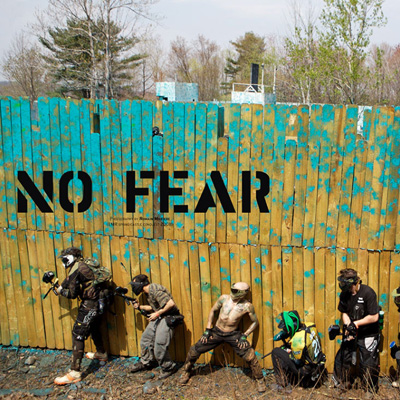

EMR Castle Conquest is one of the most iconic and enduring paintball scenario games in the world. Held at EMR Paintball Park in New Milford, Pennsylvania, this annual event draws paintball enthusiasts from all over to participate in a massive and immersive battle scenario. In this article, we’ll explore the history, gameplay, and excitement of EMR Castle Conquest.
The Boss
History: EMR Castle Conquest has a rich history dating back to its inception in 1987. It was created by Randy “Sidekick” Smith and originally played at Skirmish USA before moving to EMR Paintball Park. Over the years, it has grown in popularity, becoming a staple event in the paintball community.
Gameplay: The heart of EMR Castle Conquest lies in its unique gameplay. The event typically centers around a large-scale scenario that simulates a historical battle. The primary objective is for one side to capture and control a central castle while the other side defends it. The game often spans an entire weekend and features various missions and objectives, adding depth to the experience.
Immersive Scenarios: What sets EMR Castle Conquest apart is the dedication to creating immersive scenarios. The organizers go to great lengths to design detailed game maps, complete with bunkers, structures, and props that enhance the atmosphere. Participants often come dressed in themed costumes and gear to fully embrace the historical setting.
Massive Player Turnout: One of the hallmarks of EMR Castle Conquest is its massive player turnout. It’s not uncommon for hundreds of players to gather for this event, making it a grand spectacle of paintball warfare. The sheer scale of the game adds to the excitement and camaraderie among participants.
Community and Tradition: EMR Castle Conquest has become a cherished tradition for many paintball players. It’s not just about the gameplay; it’s also about the sense of community and the friendships formed on and off the field. Many players return year after year to relive the experience and introduce newcomers to the world of scenario paintball.
Conclusion: EMR Castle Conquest stands as a testament to the enduring appeal of paintball scenario games. Its rich history, immersive gameplay, and passionate community have made it a must-attend event for paintball enthusiasts. Whether you’re a seasoned scenario player or a newcomer looking to immerse yourself in the world of paintball battles, EMR Castle Conquest offers an unforgettable experience that continues to capture the hearts of players.


1 300 Blue Players
We were massing on the lower hill when the barrage came in-green grenades, blue balls, arcing through the overcast morning and exploding all around us. The ground was slick with mud. Our markers were slick with paint. It was an uphill battle, and they held the high ground…
Text and photography by James Dawson
…and the Castle-Castle Aaarrgh, an acre and a half of two-story ramparts, three-story towers, a courtyard littered with bunkers, and enclosed walls alive with players. The outer walls bristled with marker barrels, like hair standing up on the back of your neck. Players popped up hither and yon, bouncing over the ramparts and past the open shooting ports like human whack-a-mole with paintballs…only we couldn’t whack the moles-they whacked us.
There is a good reason that few great battles have ever been won uphill, and it has everything to do with the angles. Paintball is a game of angles, more so than pool or chess, or at least it hurts more when you botch an angle in paintball. With paint coming down, it can go just a little bit farther-its drop corresponds with the curvature of the land, and so bleeds less energy and travels farther than ours as we shot uphill. Our balls had to gain on the Castle, and gain altitude, shooting the hypotenuse of the triangle rather than a flat angle; and the hypotenuse is always longer than the base. The balls broke on the wall, and broke on the ramparts, and bounced off the players.
Occasionally one caught the corner of hard goggles, or expended its energy in a brilliant blue explosion on a hopper; but mostly our balls landed low and rumbled the wood harmlessly.
Uphill battles-that’s an art. And that’s why players come here, to EMR Paintball in New Milford, PA, every year: to attack, or defend, the hilly terrain and this amazing castle.
In an hour’s worth of reinsertions we were to the wall. Occasionally a marker burst out from between ramparts and pointed down at us, but at such close range we made quick work of them-quick work of their hands and hoppers and markers, turning each a slimy blue.
They didn’t repeat that mistake too often.
The defenders knew what they were doing; so did we, and the odds were stacked in our favor. Yet wave after wave was repelled from the 11:00 starting horn clear through our eventual emplacement right against their walls. Pub Crawling held Wall 2, the one we pushed against up this hill, and laid on their triggers like their very lives depended on it-which they didn’t, of course, but the effect was the same. Two Pub Crawling players manned each window, with a strong deployment on the ramparts above. By shooting out of both sides of the windows and working angles from the ramparts, they had lanes of fire that protected the hillcrest for far longer than anyone expected.
But it fell, in time; then it was a battle at their gate.
Enemy at the Gate
Castle Aaarrgh’s walls are hollow, with protected corridors all through them. Where the first-floor wall breaks for a gateway, the corridor stops with a doorway and resumes on the other side-making natural defensive positions for working side angles within the gateway itself. Players stacked two and three deep in these doorways, shooting over each other’s shoulders and taking their turns at the front when one got dropped.
Penetrating their lanes of fire is tough; but they made it even harder. There had been considerable rain before the event, and many of the barrels used for ancillary fortification were full of rainwater. As part of their strategy, defense-leaders Joint Fury consolidated the rainwater into a number of rather full barrels. These were placed defensively around the doorways, and with the water’s weight and the paint’s slipperiness, proved nearly impossible to move.
Every ten minutes the defenders refreshed their ranks with a new reinsertion, strengthening their manpower behind these immobile fortifications. They brought fresh pods, fresh compressed air tanks, and fresh resolve. Overhead, players had cases of paint-full cases-opened and at the ready, waiting to pour through hoppers and fly out of markers. We had pods in our packs and paintgrenades dangling from gear loops, and did our best to keep up.
The odds for this siege: 4 to 1. 260 players defended ten props inside these walls. 1,040 of us attacked, trying to remove four props by 2:00pm. If we did that, the game would go as long as it has to, until we removed all ten from the courtyard. We were more than an hour into the game before getting to the wall; and the other attackers were in similar straights.


Blue’s Crew
«I tried to lead charges over here a number of times,» Blue-field owner and leader of Blue’s Crew-said, while covered in paint. «Then over there…all different angles. We are just trying to stir up the teams, get them moving.» Backed by principle home team Blue’s Crew, Blue charged down the dirt road bisecting the field and led the push against the turret on the corner of Walls 4 and 1. Unincorporated players and a few cohesive teams followed, flooding the road and filling the air with paint.
They inspired teams on the hill above Wall 4 to open up, and the air turned into a maelstrom of paint and wind. The forward-most players threw paintgrenades at the windows and over the walls. The midrange players trained their muzzles on the parapet and turret. The rearmost players pointed their markers in the general direction of the commotion, their paintballs landing short and repeatedly hitting their own forward players. It was pure paintball insanity-as advertised-and they weren’t even through the walls.
Repelled, Blue and blue-splattered teammates returned to the reinsertion zone.
The attackers have a historically unfair advantage: four to one manpower. Blue explained that this is historic, as most successful military sieges employed at least four attackers for every defender-the manpower overcomes the inherent benefit of being protected by a castle or fort.
But the defenders have their own unfair advantage: reinsertions twice as frequently, and one third as far away, as the attackers. While Blue’s Crew and company have to march down the sloping field to the International Paintball Museum, the defenders only have to dash a few yards across the courtyard or through the walls to reach their own reinsertion zone. And, they rejoin the game every ten minutes, to the attackers’ twenty.
On the whole, these unfair advantages rather fairly balance out.
And on the whole, the attackers usually breach the walls some time shortly after one o’clock. They have a number of props in their control by two o’clock, and the game keeps rolling until, usually around three o’clock, they have the props and physical control of the castle.


But as yet another advance was beaten back-this time from Wall 3-the attackers had only a skeleton crew alongside the walls by one o’clock. And at that, they lacked most of the footholds necessary to advance players from their burgeoning rear echelon to the front, where they were needed.
The defenders held all the cards-and all the props.
Then, fresh with the manpower of another reinsertion, Blue, the Crew, and company swooped down the dirt trail leading away from Wall 3, and charged the longer of two gangplanks up the wall. As the ground sloped down away from the plank the players charged up onto the ramparts, Blue in the lead. He got cut down by withering fire from inside the courtyard, balls coming unimpeded by the last gap-toothed section of old wall.
The player behind him in a red and black shirt got cut down as well, and crouched with Blue out of the way to keep from getting hit like bunkers in the NPPL. Then a shirtless berserker charged up the gangplank, flopped to his belly and crawled-nay, swam-through the blue slime covering the rampart. Though as low as he could go, he was still exposed to sharpshooters below, and took his day’s allotment of lumps and bumps and broken balls all over his bare skin. You can’t wipe the red marks.
And so the clock ticked down steadily towards the end, victory in sight-for the defenders, for once! A mad attacker dashed into the castle, evaded several paint-hurricanes, and grabbed the Royal Platter. He made it back outside, where the prop entered his team’s custody; it constituted exactly one quarter of the props they needed to extend the game beyond 2pm; and at that, the Royal Platter was but ten percent of the props they needed to win the game. Keeping up that rate of capture, the game would have lasted twenty-five hours.
1:55 came and went and ushered in 1:56, every passing moment marked with hundreds of shots from inside, and dwindling fire from outside. A detachment of attackers made it up the second gangplank on Wall 3, near the edge of Wall 4, but were viciously repelled. Stacks of attackers lined up against the walls, yearning for an opportunity to burst into the courtyard, but stood their ground in vain. The barrels were unmovable between the weight, the paint, and the lanes of fire that cut down attackers like wheat chaff.
At 2:00, the game was called-victory for the defenders, the first time in years!
In Defense of Castle Aaarrgh
This was the season for Joint Fury, a team comprised of members of other teams that band together for the common cause: viciously repelling Blue’s Crew. And playing other games too, of course. They were joined in victory this year by Delta Paintball, PA Brew Crew, SF Wicked Wombats, Shadow Company, and others, as well as a few celebrity guests-Dennis Tippmann among them-and random players. By far the ideal role to play, the defenders were decided by splitting the EMR home teams down the middle and inviting certain other players and teams. Once their ranks filled, that was it-waitlist time for everyone else who wanted to defend.
They were met upon the field of honor by Blue’s Crew, Ambush Alpha, Binary Specter, Black Sheep Squad, Fox 4, Ferrmen, Hell’s Henchmen, and many others. In the fall, EMR will host another Castle Conquest-XXIV-to close their Big 4 season for 2007. Then, the defenders and attackers will be switched up, while everything else remains the same.
After Game


The Castle Conquest events are about more than just paintball-they’re about a sense of community between the participants. The weekend warriors go home after the game; some went home even before sides were redrawn and the second Castle Conquest played out that afternoon. But the home teams, their friends, and the stalwarts stay for the evening. That’s when the other side of EMR comes out.
Boneheads, Ferrymen, and company threw their regular joint feast, and invited the neighbors in. Folks brought food of their own to add to something of a potluck feel, and players gathered under tent tops to eat and relive the day’s adventures.
Delta Paintball Team threw a Pirates of the Caribbean theme party, with all sorts of games and fun. Eric Engler and Wedge dressed to the nines, complete with swords and sashes. A good time was had by all, and very, very few players were awake in time for the 10am games on Sunday.
The game attracts the players; the camping and festivities attract the families; and everyone enjoys a full weekend of paintball and camaraderie at Castle Conquest. This is why there have been twenty-three of them, and this is why there will be many, many more.
ARTICLE IN PROGRESS.

If you have original publications : send it contact@paintball-story.com
Or ship it to :
ATOMIK PAINTBALL
14 Rue du Petit Albi
95800 CERGY
FRANCE
Tel : +33134220015
THE PAINTBALL BOOKS


INTERNATIONAL PAINTBALL PRESS


FRENCH PAINTBALL MAGAZIN


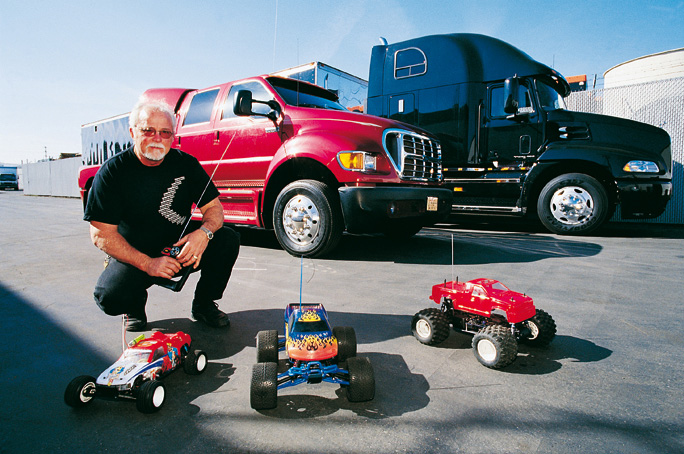
TO BE ORR NOT TO BE
Budd Orr, they fifty-eight year young Worr Games Product boss isn’t about to retire, and that’s good news for all of us.
BY MATT MARSHALL/PHOTOGRAPHY BY ROM 123
A father sits in his running car, looking past the dash, the steering wheel, he’s boozed, hammered, The engine hums. Light catches the faint emission as it billows in pale blueness.
A son walks up to the to the window. The mother had called to elicit his help. A marriage and a life was crumbling, domestic pieces needed to be picked up and made whole. He carries his father, out to the lawn, stands him up.
“Hey Dad.”
“Hey.”
The son looks at the father, knowing he’s old, knowing help is needed, knowing that as much as he can put forth in this department, it might not be enough.
“You got to lay off the booze Dad.
You’ve got to get some help.”
“you know why I drink.”
“yeah… in the morning I think you should go to a place where you can get help.”
And the Father didn’t want to go, of course-but he went. He went because Bud Orr didn’t want to see the elder part of his father’s life fade away into the drink.
Bud Orr looks the part, 200 plus, odin-like in muscular stature. He looks old school, like there’s a history, a story waiting to be told. He’s big in the way your father was big, larger than life, an authority figure sitting and presiding over his territory without using words to reign, just the sullen and long expression of experience.
But even though his largeness comes across blatantly, he does not wield this as weapon. In fact, as I stand in the Worr Games office a little south of Los Angeles, watch his co-workers bustle about with the day’s activities, watch the shape of an old company transform and morph before me, I smile. This is no longer your average everyday paintball company. Change is here and now. Worr Games is not towing the traditional line, not staying with the stock, simply not content to be average.
The machine shop where the bulk of all Worr Games products are made is not what the 15 year olds in Florida thinks it is. It’s not a huge expanse of building solely made for the company. The shop is housed in a aging industrial complex. Each one of the bays in Bud’s stretch of building was taken over as the company grew, until there were none left, forcing him to get another, larger building, which is just about ready for them to move into, where they will finally have enough room to breathe, spread their wings a bit.
The shop holds remnants of the company’s history, of Bud’s history, and his office is the central hub of busy network of employees. There are pieces of cars and engines through the entire place, machine shop trinkets on casual display in the office. The whole time I was there, the work space appeared communal, filled with people coming to the from meetings, displaying new products for approval, discussing numbers, proposals and dates, all while Bud sat like the sun, his solar system of cohorts gravitating around him in a fixed and complicated clock work. It took awhile for the cluttered chaos of midday business to clear and for Bud to have time to talk. But when we did finally sit down and I asked about his life, about his story, everybody faded away, he took no calls, handled no business other than that of talking about a paintball birth and Autococker legacy.
“I call them redneck,” Bud says about his parents, which comes off a comedic, but he says this with genuine affection. In fact, Bud seems to say everything with genuine affection, like it’s the last time he will ever talk about the matter, like it’s the “According to Hoyle” version of life explanation, which at first you chalk up to the interview and its decisiveness, only, when you hear the reverence in the voices of the people who work for him you understand that this affection is real, genuine. When they speak of Bud and his business, they lean close, open eyes wide, and slow their speech, talking descriptions and wonder and happiness.
“Yeah, my parents were definitely from the old ways, which was fine; it taught you discipline,” he says. He was born in Fort Lauderdale, Florida, but spent 16 years in Miami, leaving for California in ’59, where he was stationed at Travis Air Force base in Northern California, near San Francisco. He had twin boys, Robert and Jeff a little bit after that, when he was only 19. “I grew up with my kids,” he says. It was a mutual growth experience for them, with the boys coming while he was so young, they grew and matured together. The whole time I was at the factory, I never saw Jeff Orr, who run the machine shop. But they way that Bud spoke of him, spoke of the operation, I felt he was always lurking about, Autococker in hand, making things work.
Everybody knows this man for the creation of the Autococker, but what he really was excited about, what nobody knows, it his magic with all things mechanical. The look of the Autococker is a mirror image of Bud’s profession like, a bunch of random pieces put together in seamless working order, making function exist were there was none before. Bud is a mechanical genuine, not by his own reckoning, but by his results. He has spent his entire life making things work, and work well. Cars, motorcycles, airplanes, ships; if it has moving parts, he finds it fascinating enough to tinker with and make sing. He once put an entire car together, by himself, in four days; it was featured in a national magazine profile. A few of his cars have won races.”I’m always trying to make the circle rounded, to make things work better than they already do.” And that is how he got into paintball. His daughter went out to play, came back saying she had a great time
And got her dad out to the field the next week. They Bud bought a gun, modified it, still wasn’t happy and decided to make his own. He called it the DC-9, because it looked like the tail of a DC-9 airplane. It could run on CO2 or compressed air, making it one of the first guns ever to be hooked up with compressed air.
While we were talking, the first sniper ever make, which is the pump predecessor to the Autococker, was leaning Excalibur like, up against Bud’s desk. In a hundred years, if this spot is still around, that gun will probably be worth more than the whole building. But Bud picks it up and shows it to me like it has no significance, like he just built it yesterday, like it’s 1986, and he wants to know what I think. As he goes into the gun’s history, talking about how he assembled the most accurate gun in the history of our sport in eight hours, made it work; He stares long and hard, works the pump action, and you understand why he’s successful, why his workaholic, 20 hour a day ethic has shaped the game I play for living. Advertising rhetoric aside, this piece of metal is function becoming from and I am staggered. Then he tells me he’s dyslexic. And I hold the sniper, take a breath, grasp in awe. A man who took years to learn how to read a sentence, built and designed the base from which the gun was built that has won more world titles and NPPL championships than any other, and he did it in eight hours. Holy Shift.
Of course, it took years to get the gun to where it was ultra-reliable, and that was a immense process in itself, one filled with trial and error, with many people and teams involved. The first gun sponsor of the Ironmen was Worr Games, who Bud said nobody would even touch because they were the “cheatingist sons of bitches you’d ever seen”. But he knew in order to get big they’d have to clean up their act, which they did, and Bobby Long started a great team/sponsor relationship with Bud’s company; the Ironmen were the first Worr Game factory team, in 1990. They Bushwhackers are also sponsored heavily in part because Ron Killborne and Bud have been close friends since 1985.
Tom kayne, who owns and operates Airguns Designs, is a close friends of Bud’s, which is peculiar because the companies have always been fierce competitors in the paintball market, or at least, that’s the public conception of the relationship between the two companies. But the reality is much more interesting. The companies have been closely linked since their inception. When Tom say that Bud was still doing all his design by hand, he gave him his CAD program and showed him how to use it. Bud continues to design his products on it. Tom also helped Bud do his books for a while in the beginning, and they traded ideas constantly, always bouncing to the phone to talk about the next big thing. Bud only gets tense when he talk about the after effects on the Autococker revolution and how in business, imitation is not the most sincere from of flattery, it is the most insulting. The Autococker has been copied by many people, and Bud is quick to point out he’s not rich, just making a good living and building his business. In his mind, all the people who are making their won autococker bodies are stealing from him, and when you look at it from his point of view, he’s right. He’s a man who has been forthcoming in his work, tried to make the best product he could, and other people are copying his ideas, and making money from it. The people who are doing this day it’s the American way, and if you mean legal, then yes, it is legal, so far, but to Bud, a man who has spent his entire career trying to make his inventions better, to make “the circle rounder”, It’s flat out theft. He points out that his company gives back to the players over $400,000 dollars a year to the players, not the promoters. A tour around the factory is a walk through Autococker wonderland. I ask Bud what he thinks about all the electronic markers on the market, if he has any plans to make one or deal with the change in the industry. Sonny Lopez, who is the executive director of the company answers for him with smile, and says, “ Expect big things.” “I can’t make enough of my guns now to meet the demand, so as far as those electronic markers cutting into my sales…well, it can’t be that bad”, and he’s right. They way the industry is now there’s room for both types of markers; both companies are successful, Bud’s brought in a bunch of young, new people into his company, and things new, cutting into the old image of the company with CNC like creativity. Color and shape is no longer constrained by tradition, and with the move into new facilities, the company is shedding its skin, growing up and out. Bud is embracing the new look, the new personnel and talks about his employees like he talks about his own children. They way he runs his business, they are his children, and he keeps them close, but opens up the reigns to new routes. I ask Bud if he plans on retiring any time soon. He looks at me like I don’t know his life, like this choice should be apparent and starts talking about how he could take time off if he wanted to. Bud this man will never stop the race, never lay down, never stand still and say everything’s all right the way it is, it’s just not his nature. He is and always will be a man who tinkers, trying to make things better for the world around him.
THE AUTOCOCKER


THE RANGER


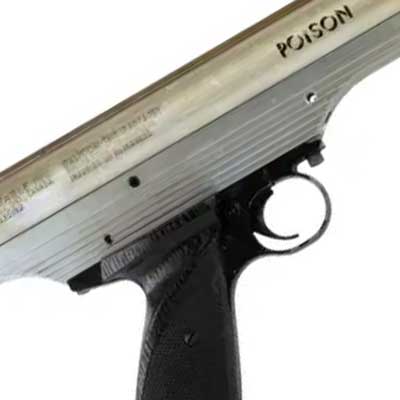
A Visual Story of Unique Paintball Guns:
Paintball is a sport celebrated for its diversity, not only in gameplay but also in the array of paintball markers available to players. While sleek, modern markers dominate the scene, there exists a fascinating world of paintball guns with quirky, distinctive looks that have captured the imagination of enthusiasts. In this visual journey, we’ll explore some of the most unique paintball markers from the likes of Carter Machine, ZAP, Brass Eagle, and Indian Creek, each with its own peculiar charm.
Carter Machine: The Art of Simplicity
Carter Machine has earned a reputation for producing paintball markers with an almost artistic simplicity. The Carter Buzzard, for example, is a prime example of this approach. With its exposed bolt and minimalist design, it embraces a stripped-down aesthetic that stands in stark contrast to the bulkier markers of its time. Carter Machine markers are a testament to the notion that beauty often lies in the purity of function.
ZAP: Embracing Sci-Fi Aesthetics
ZAP paintball guns take inspiration from science fiction and futuristic designs. These markers often feature sleek, streamlined bodies, and unusual shapes that wouldn’t look out of place in a sci-fi movie. The ZAP ZXS-400 is a prime example, with its striking resemblance to a laser blaster from a galaxy far, far away. ZAP markers evoke a sense of otherworldly adventure on the paintball field.
Brass Eagle: The Charm of Retro, The boss of Design
Brass Eagle has left an indelible mark on paintball history with its unique approach to marker design. The Brass Eagle Rainmaker, for instance, boasts a brass body, giving it a vintage, steampunk-like appearance. These markers harken back to the early days of paintball, reminding players of the sport’s humble beginnings while embracing a distinctive, retro charm.
Indian Creek: Engineering Marvels
Indian Creek markers are known for their intricate and innovative designs. The Indian Creek Designs (ICD) Desert Fox, for instance, features a futuristic, almost robotic appearance with a distinctive angular frame. These markers showcase a fusion of engineering prowess and a desire to push the boundaries of marker aesthetics.
In the world of paintball, markers are not just tools; they are expressions of creativity and innovation. Brands like Carter Machine, ZAP, Brass Eagle, and Indian Creek have taken unique and sometimes unconventional approaches to marker design, giving birth to paintball guns that are not only functional but visually captivating.
Whether you’re drawn to the simplicity of Carter Machine, the sci-fi allure of ZAP, the retro charm of Brass Eagle, or the engineering marvels of Indian Creek, these unique markers remind us that paintball is a sport where individuality and creativity can shine even through the barrels of the quirkiest paintball guns. These markers are a testament to the diverse and colorful world of paintball, where every player can find a marker that speaks to their style and personality.

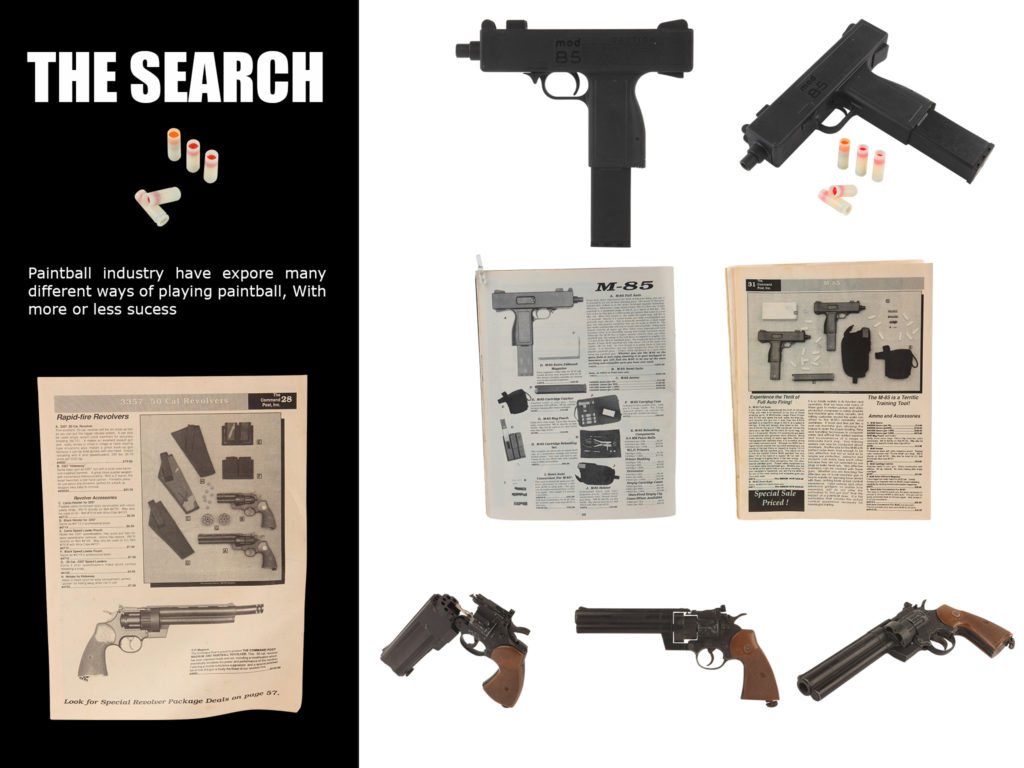
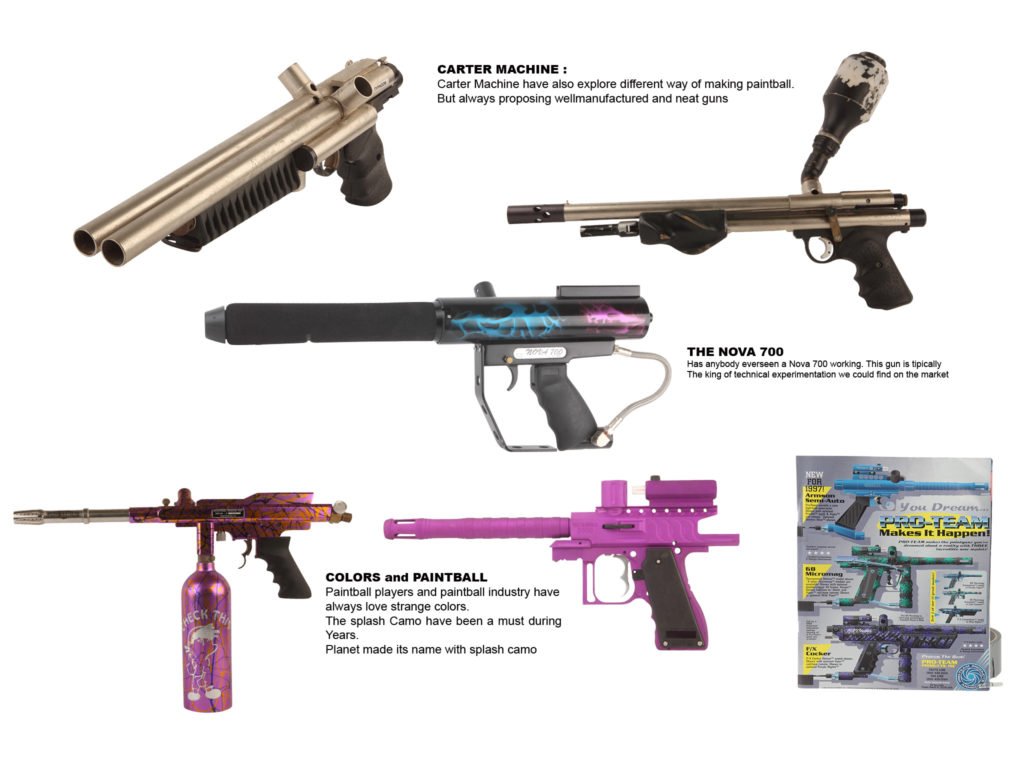


No doubts, the most creative in paintball design


OTHER ATTENDS



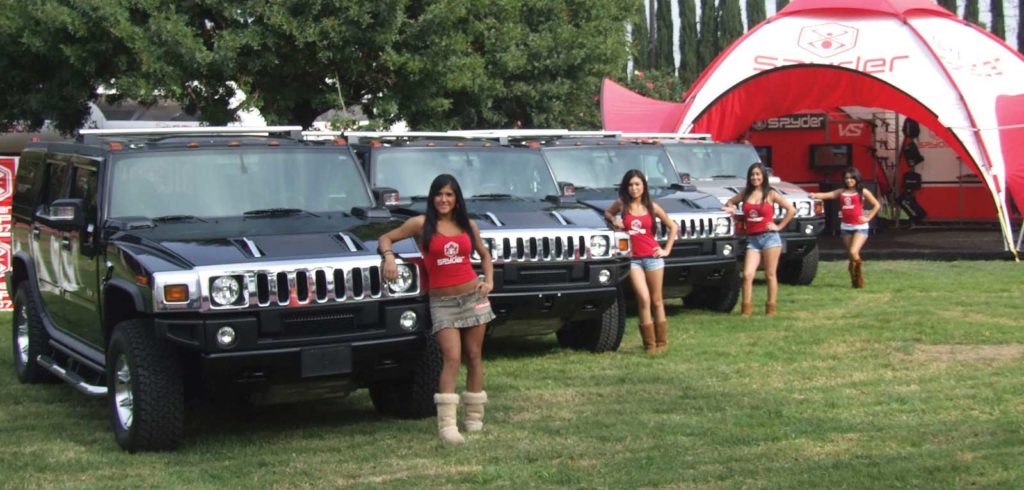
1992 – Kingman founded by Arthur Chang.
1993 – Introduction of Hammer Pump Action Seriers.
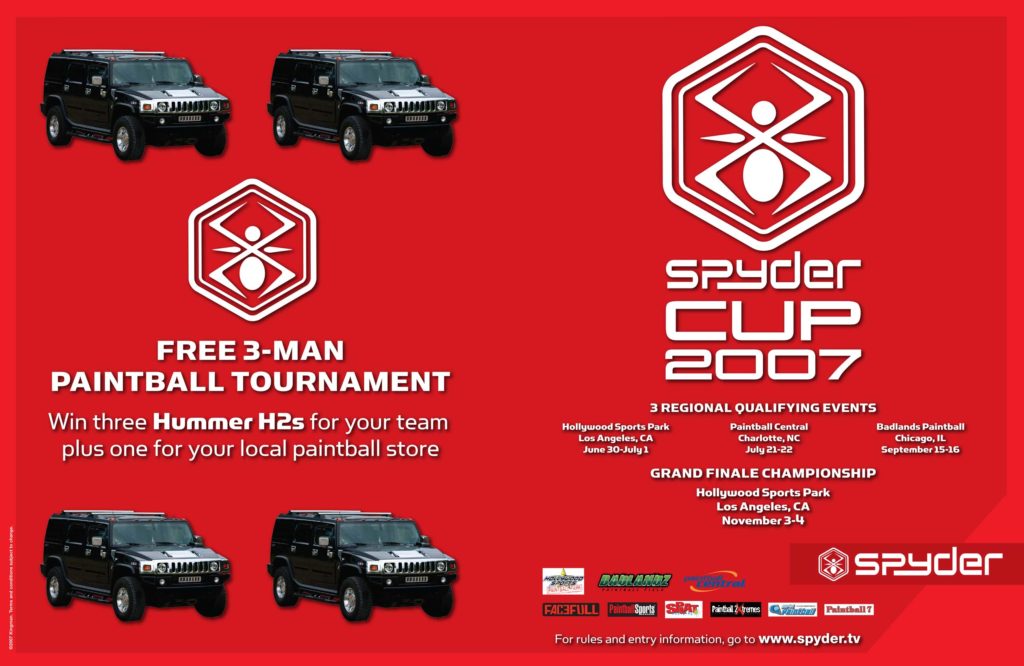
1995 – Spyder line of semi-automatic markers is launched; first marker of it’s class with a price less than $200.
1998 – Arthur Chang received the lifetime acheivment award from Xtreme
Media.


The first industrial approach of the sport
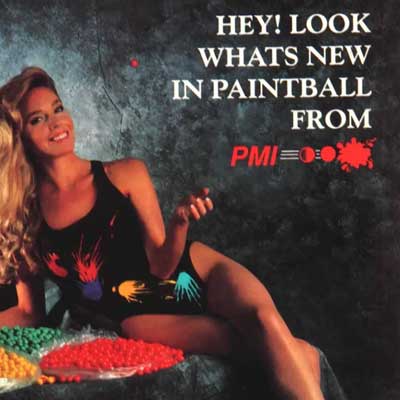
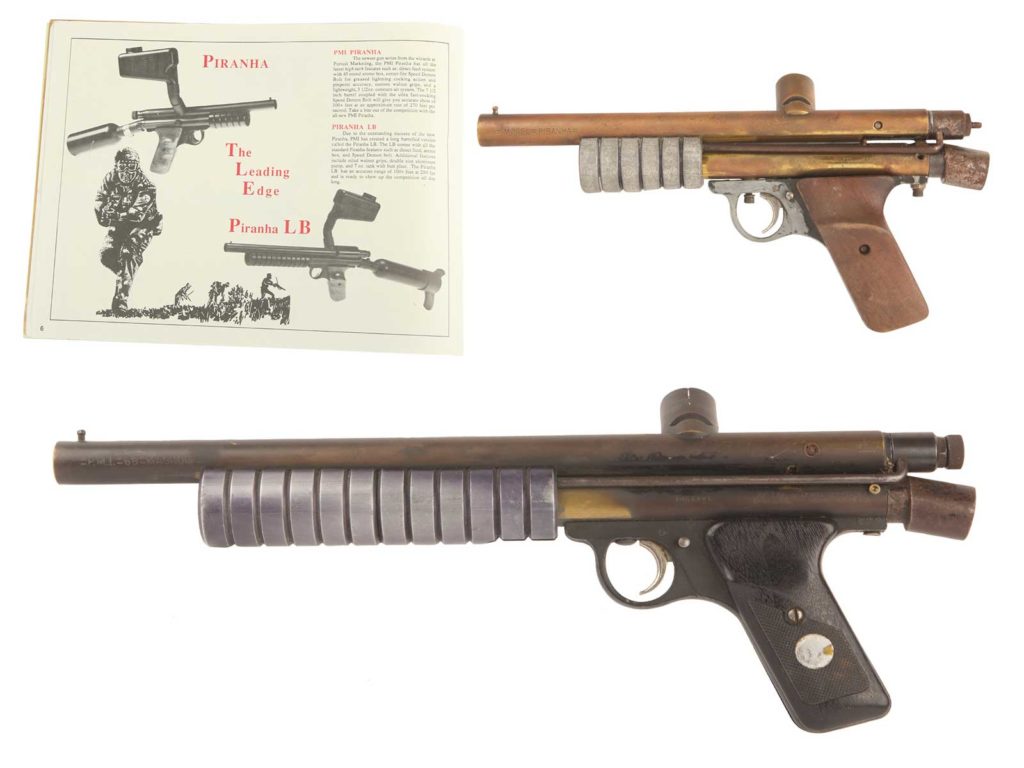
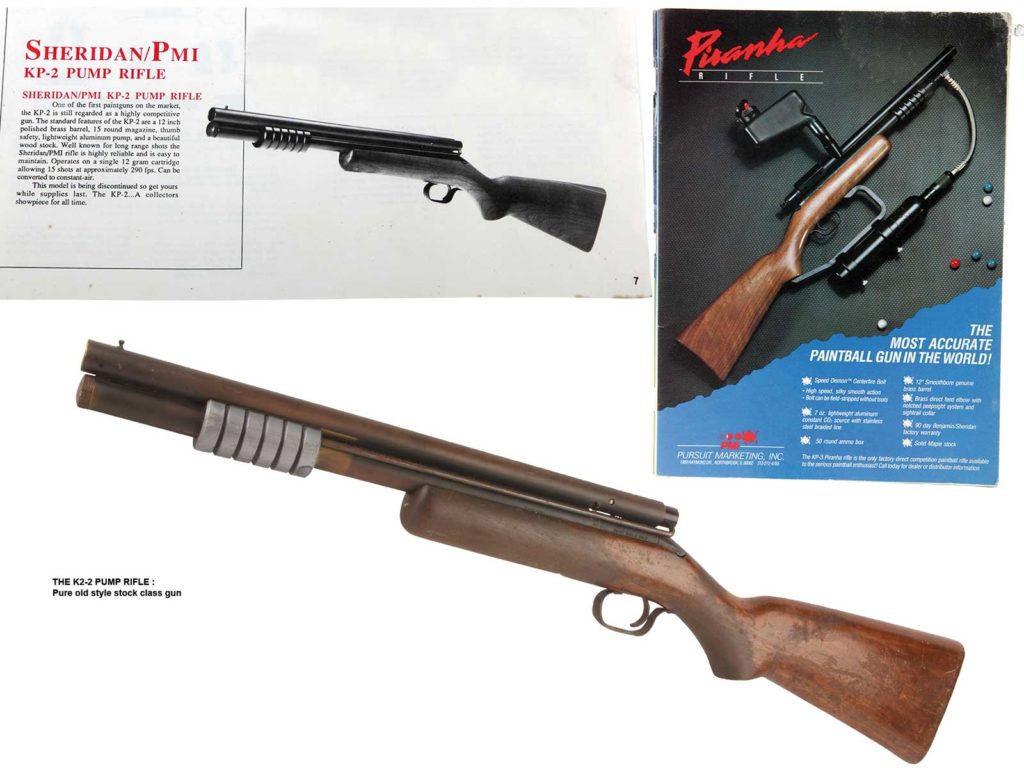
PMI (Pursuit Marketing, Inc.): Pioneering Paintball Markers and Paintballs
Introduction: Pursuit Marketing, Inc. (PMI) is a name that holds significant importance in the world of paintball. Founded in 1982, PMI played a pivotal role in the development and popularization of paintball as both a recreational activity and a competitive sport. In this article, we’ll explore the history of PMI, their contributions to the paintball industry, and the range of paintball markers and paintballs they’ve manufactured.
The Early Days: PMI was established during the early years of paintball’s emergence as a sport. At that time, paintball markers were still in their infancy, and the sport itself was just beginning to take shape. PMI was among the companies that recognized the potential of paintball and played a vital role in its growth.
Manufacturing Paintball Markers: One of PMI’s primary contributions to the paintball industry was the production of paintball markers, also known as paintball guns. They developed a variety of markers that catered to different player preferences and skill levels. Some notable PMI markers include:
PMI-3: The PMI-3 was one of PMI’s earliest markers and became popular for its simplicity and reliability. It laid the foundation for future PMI markers.
Sheridan PGP (Pursuit Pistol): PMI acquired the rights to manufacture the iconic Sheridan PGP, a pump-action marker celebrated for its accuracy and durability.
PMI-1: This semi-automatic marker was designed for tournament play, offering improved firing rates and precision.
VM-68: The VM-68 was a semi-automatic marker known for its ruggedness and suitability for both recreational and competitive play.
Paintball Manufacturing: In addition to markers, PMI was also involved in the production of paintballs, a critical component of the sport. They manufactured high-quality paintballs that met industry standards, ensuring consistent performance on the field. PMI’s commitment to producing reliable paintballs contributed to the overall growth and legitimacy of paintball as a sport.
Legacy and Impact: PMI played a pioneering role in shaping the early paintball industry. Their markers and paintballs became integral parts of the sport, enjoyed by players worldwide. Over the years, PMI evolved and contributed to the evolution of paintball technology, leaving a lasting legacy.
Pursuit Marketing, Inc. (PMI) holds a significant place in the history of paintball. Their dedication to manufacturing paintball markers and paintballs helped establish paintball as a widely recognized and beloved recreational activity and sport. PMI’s contributions to the industry continue to be remembered and appreciated by paintball enthusiasts, and their legacy lives on in the ongoing development of paintball equipment and technology.



THE TRRACER PUMP GUN


ARTICLE IN PROGRESS.
Article in progress
In a Galaxy far far away………..
(Well, Manchester, England),
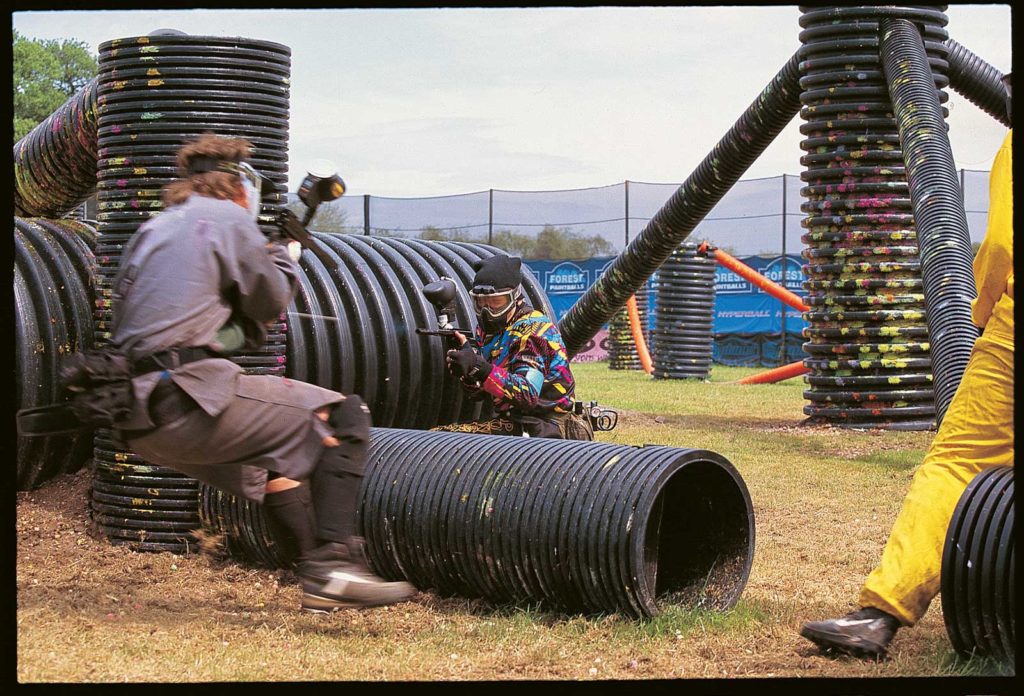
There were two lads doing things, getting by, making a living, a little bit bored, looking for a break, something to do, a chance to shine. Meet Julian and Leds…. Julian Carr, entrepreneur, wheeler-dealer, geeza. Anthony “Ledz” Leadbetter, beer-drinker, ‘baller, good-time guy. Together, founders, then partners, now directors of one in paintball: Planet Eclipse.
STORY
It’s 1991 and Julian is selling stuff out of the back of a van. Literally, selling stuff out of the back of a van. Paintball gear, mainly imported from America, was the bread and butter, and on the back of that, a side-line in manufacturing and selling CO2 bottle valves. Pi-valves at first, and later on/off valves, they were the best quality valves you could buy for a paintball gun, and ones he sold all over the world, the USA included. In fact, even Smart Parts at one point had all their valves supplied by Julian. It’s the kind of attention to detail that Julian took in manufacturing these valves that would shine through later in everything Planet Eclipse would produce.
But back in England he’d be spending all week traveling the length and breadth of the British Isles buying, selling and trading gear, But this paintball gear side of his life was basically an accident. It wasn’t really a path he initially chose. Before all that he was educated and trained through college as a Dental Technician, making moulds, bridges and false teeth for dentists, a practice he must have used more than once repairing injuries from his days as an American Football player. A short-lived career terminated by a broken back, gained during an untimely tackle playing the game. Luckily for him, and the rest of the paintball world, it wasn’t critical and wasn’t the kind of break that you normally associate with the kind of injury. No severed spinal column. No paralysis. Just no more American Football for Julian. But the paintball was really thrust on him by his uncle. Even more of a wheeler-dealer than Julian, but just nowhere near as good, he was the type of entrepreneur who liked to spend all the company’s earning before the company had actually earned anything. His fly-by-night, door-to-door paintball business was going to the wall, only this time Julian, who had nothing to do with the business at this point, was his uncle’s signed Goarantor. See where this is going? Rather than letting everything go to crap, and himself end up black-listed for his uncle’s incompetence, Julian had no option but to make over and at least try to repay the debts that were signed against his name. With no-one to bail him out, and no-one to turn to, it was a do-or-die situation. And that is how Julian Carr became a paintball salesman.
Over on the other side of town, and Ledz is sitting in an office, selling vehicle leasing, Yawn. Having left school with just one qualification, in digging (yes that is a qualification in digging holes in the ground!) to his name, I think most people were surprised he got any job at all. But the qualifications meant nothing to Ledz. He just wasn’t a “school” type of person. With a sharp mind, sense of humor and a domineering kind of personality, there is little that he cannot achieve once his mind is set to task. Anyone who has ever tried to argue a point with Mr Ledz will know just how quick his mind can work, how stubborn a personality he has and how competitive he is in everything he does. He never like to be beaten, at anything, and will never back down from a challenge. But still living at home, with his Dad and step-mother, sister and two step-brothers, life was pretty good. So good, in fact, that he continued to live at home into his thirties. There was absolutely no point in moving out when he had a restaurant, laundry, maid and cleaning service as complimentary additions to a roof over his head, in exchange for an absolute pittance in return. A nice house, in a nice neighborhood, plenty of money in his pocket, but a slave to the wage non-the-less. Bored, looking for something to do.
AHHH, PAINTBALL
But ledz had found a past-time he loved. And every waking spare moment was spent plotting and dreaming about playing paintball. He’d formed a paintball team with his mates, a few years before, starting with Splatmasters and PGPs, before following the technological advances of the times of pumps. His team, the Banzai Bandits were having more than a little success, and the squad grew, picking up players from all over Manchester. In the usual way that teams do, the Banzais made money from reffing at their local field and whilst there, Ledz picked up the nephew of the site owner to lay on the team. Grahman Wildman was the owner of the site as well as a store based in Manchester, and his nephew, Jack Wood, had been working and playing on his site from the age of 14. Now, at the age of 17, he was spending his summers working full-time, split between the store and the site, but spent the rest of the year in the south of England, in Hereford, the home of the infamous SAS, at college. But that didn’t stop him playing, or working, in paintball. The next few year were spent playing with the Banzais whilst he finished up his A-levels and spent a year in Industry in Birmingham before moving to Manchester to study Engineering at University in ’91.
With his Uncle struggling to cope with the fatal illness of his wife at the time, and his two protégée store managers deserting him to set up their own paintball store literally
It was inevitable that Julian and Ledz would meet, and with Julian’s access to cheap imported paintball equipment, it was obvious there was potential for a nice hook-up for Ledz and his team. But things progressed further than that, and Julian was actually drafted to the Banzai squad and became a serious 1st team player.
100 yards down the same street, Jack ended up running the store on his own whilst studying at university. As back-up on the busy Saturdays in the store, and when he wasn’t off watching Manchester City play football, Ledz would come in to help out his team-mate. The job made Ledz some extra paintball cash, gave him access to cheap paintball equipment, and sparked his interest in owning his own store. It was inevitable that Julian and Ledz would meet, and with Julian’s access to cheap imported paintball equipment, it was obvious there was potential for a nice hook-up for Ledz and his team. But things progressed further than that, and Julian was actually drafted to the Banzai squad and became a serious 1st team player. And from there, the obvious happened. Over man, many paints in boozers all over the country following the paintball circuit, plans were hatched and cogs put in motion. Julian and Ledz saw the opportunity to take over Manchester Paintball from Graham, whole enthusiasm for the business was all but dead, and turn it around to be a profitable and viable business. They approached Graham, offers were accepted, and the deal was done. In 1993 Ledz and Julian became the proud owners of their very own paintball company and as a fixture and fitting of the company, and player on the Banzais, Jack Wood was thrown in for free.
PAINTBALL PLANET
News company, new start, new name. Paintball Planet was born. By this time, the competition down the road were by-far the dominant force. They had all the deals, all the distribution rights for all the hottest gear, the better laid-out store, and all the customers. It appeared suicide to take on a business in such close proximity to such a successful competitor. But there was method in this apparent madness. To start with, Julian had access to newer, hotter, and cheaper products through his direct American connections. Combine that with almost guaranteed passing paintball trade going to the competitions store, and it wasn’t long before every paintballer was making the trip to Manchester to what had become the Mecca for paintball in the north of England. Two excellent shops selling shops selling the best and latest equipment, at prices that only two companies too stubborn, at prices that only two companies too stubborn and proud to agree stable prices could produce. If you loved to haggle, loved paintball and needed some new paintball gear, Deansgate, Manchester was the place to go.
But it didn’t take long to realize that Planet had a little something else to offer. Jack, a natural tinkerer with an inquisitive nature had already been performing surgery on a variety of markers for his team. And as Planet started to grow, and the cocker started to emerge as one of the top two domiant markers on the circuit, his marker upgrades became sort-after fare. Players were soon sending markers from all over the country to Planet for customization. Initially trigger jobs, valve enlargements, and general tuning, and later for full cosmetic and performance packages, Planet started to offer a different level of service to that of their bitter rivals.
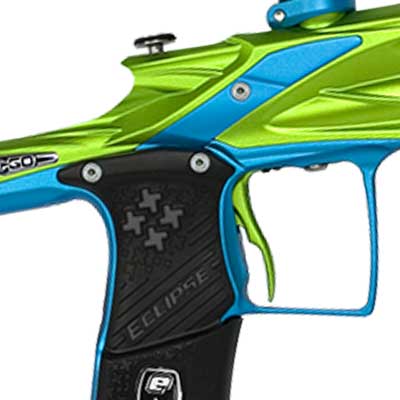
And so the Eclipse branding was born. In these early days Eclipse was the name given to their high-end custom markers, which initially consisted of just the Actococker and the Automag. They offered for the first time a complete package of customization. They were machined not only for light weight, but for style too. They utilized the very latest in andonization techniques to make them stand out from the crowd. And they offered exceptional performance, with the invaluable cache of being incredibly reliable. Later, they brand spread to cover almost every major marker of the last ten years. Eclipse versions of Bushmasters, Spyders, Shockers, Impulses and of course Angles can still be seen being used on fields all over the world.
As a store selling paintballing product to the British public Paintball Planet was a success in its own rights. It was only a couple of years before they had such a domiant control of the northern market that their close, local rivals were forced to close down. But not everything went quit so smoothly. As the company grew Julian and Ledz looked to make the company a “Limited” Company. This process requires the company name to be registered at Companies House, a government facility where all the details of all Ltd Companies is kept. However, it transpired that a low-life local field owner who had been keeping his eye on the grown of the company had already registered the Paintball Planet Ltd name and was now demanding a fee for it to be passed over to the rightful owners. In true stubborn and defiant nature, rapture, rather than bow to this underhand plan, it was decided a name-change was in order. And paintball Planet Became Planet Eclipse Ltd.
New company, new start, new name. Paintball Planet was born. By this time, the competition down the road were by far the dominant force. They had all the deals, all the distribution rights for all the hottest gear, the better laid out store, and all the customers.
But with the Banzais starting to play abroad, particularly in the USA, it didn’t take long to realize that there was a massive market for their unique style of marker customization waiting to be tapped into. But it wasn’t really until the arrival of the Eclipse Angel that that dream could be at least partially realized. With WDP, another English company, in relative proximity to Planet, it was far easier to produce larger quantities of custom machines that the US market craved for. Their quantities went from producing just tens of guns to producing them in hundreds. But even that didn’t seem to be enough. Them more they produced, the bigger the back-orders appeared to get. As word got around, their popularity sky-rocketed. Around the same time, Ledz and Julian decided to take on another little challenge. In the south east of England, just outside London, they took over a second store, previously owned by one Pete Robinson. And lthough it had some minor success and was never a burden to the company as a whole, it was also never a real inspiration to its new owners. Even having the likes of Andy Piper at the helm couldn’t help rustle more than the tiniest enthusiasm. But what it did hail was the arrival of Ian “Jacko” Persons to the company. Having worked with Dave Galsworthy through the seminal years or Pro-Line and the advent of the Sterling Pump, followed by the ground-breaking time spent working with WDP during the development of the Angel; he was another valuable addition to the team that was to arrive through the Banzai Connection. Brought in to manage the London store, it was soon apparent that his expertise, talent and knowledge of the US paintball market would be best utilized in a different way. With the US sales side of the company growing at such a rate, it was obvious that presence inside the US was what was going to be required if the company was to move the next level. So Jack packed his bags and moved lock-stock with his family to Rhode Island, and Planet Eclipse USA was created. This distribution hub did indeed carry the company to another level within the US. Dealers no longer had to try to get to grips with transatlantic time zones, importing, duties, and dollar-to-pound monetary conversions. They could now deal with and buy gear from this Great British Company as though they were actually buying it from any other US distributor. At this stage, Planet were still producing custom versions of a range of markers, as well as accessories, kit bags and a large quantity of pods. Things were going well. And then along came Flash. Surprisingly, Steve “Flash” Monks was another player from the Banzais. Only his past was not in paintball (apart from the playing side) but in electronic control systems. Now how could electronic control systems be incorporated into paintball, do you think? Well, as a product “tester” some bright fool came up with the idea of trying an electronic trigger frame conversion for the Autococker. What a crazy idea! The philosophy was very much “ Lets try it, we may even sell a couple of hundred frames, and them we’ll move on to something a big more serious!” Jack and Steve sat down and started mulling over the idea, and between them, with Jack PRODUCING THE MECHANICAL ELEMENTS AND Steve the electronics, they came up with the E-Blade. Well, three years, one WGP license agreement, and countless thousand Eclipseblade Autococker Frames later, the “something a bit more serious” is launched. The Eclipse Ego, their first fully in-house designed, manufactured and assembled markers is released to the world. With less than 12 months of production under its belt, there have been Nexus and XSV team versions released, with XSV already battling every event with Dynasty for the top spot. So in almost every respect story. Two friends buy a little shop selling little paintball parts to a small paintball community. Twelve years later and their products are competing with the very best products, produced by some of the industry’s biggest companies, used by some of the best players in the world.
Julian and Ledz saw the opportunity to take over Manchester Paintball from Graham, whose enthusiasm for the business was all but dead, and turn it around to be a profitable and viable business.
Planet eclipse, founder, LEDZ, Famous Banzaï bandit Captain, The english legend of paintball.
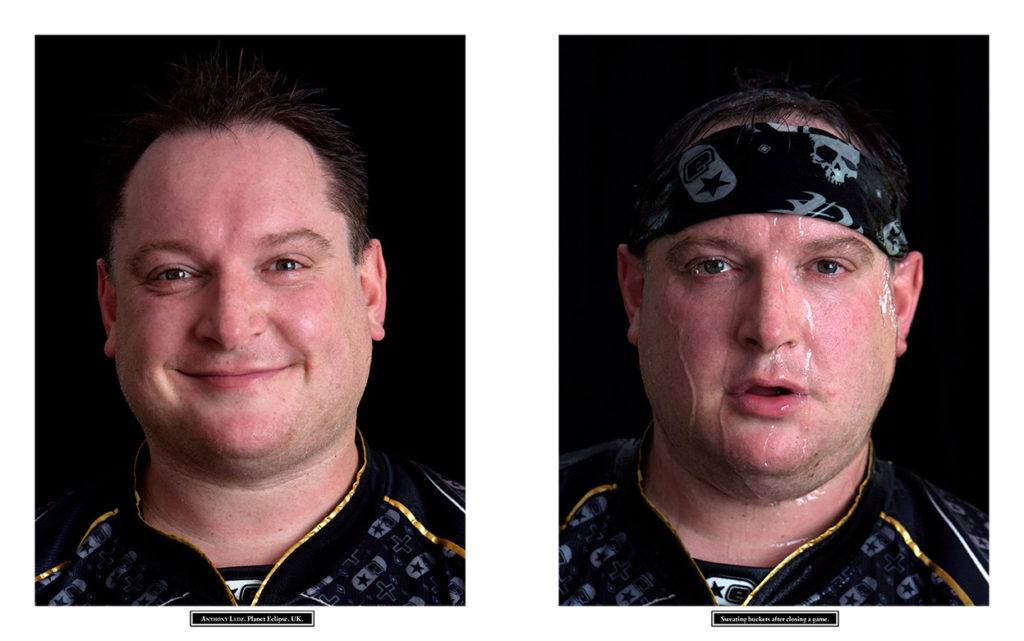
BANZAI BANDIT CAPTAIN
Jack wood
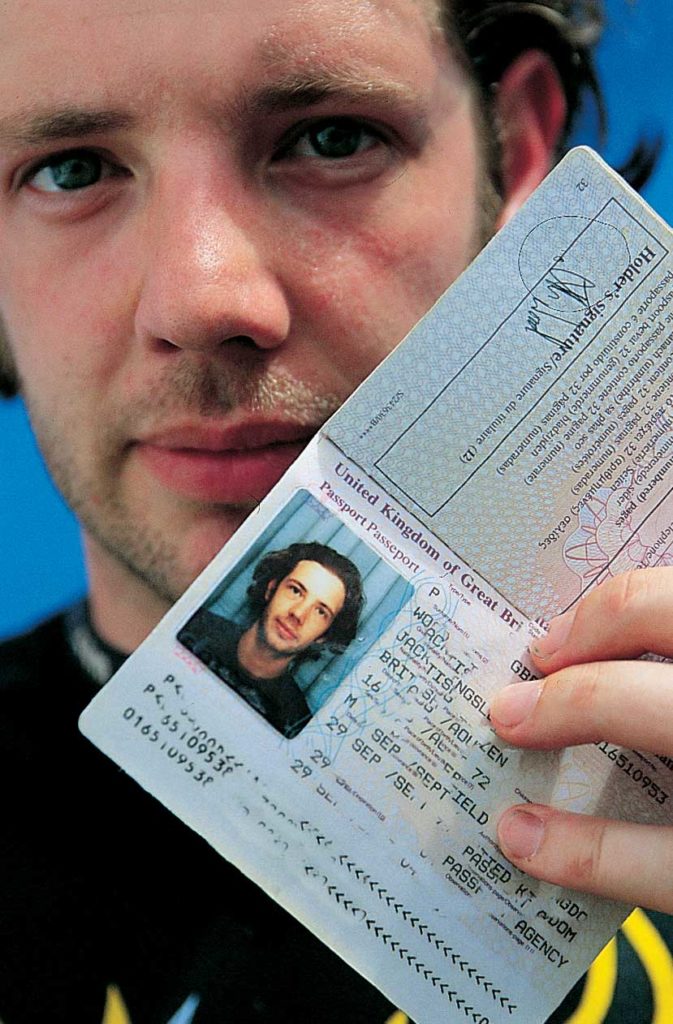
PLANET GUNS


Copyright
Romain Manière
paintballer the paintball book
FREE DOWNLOAD