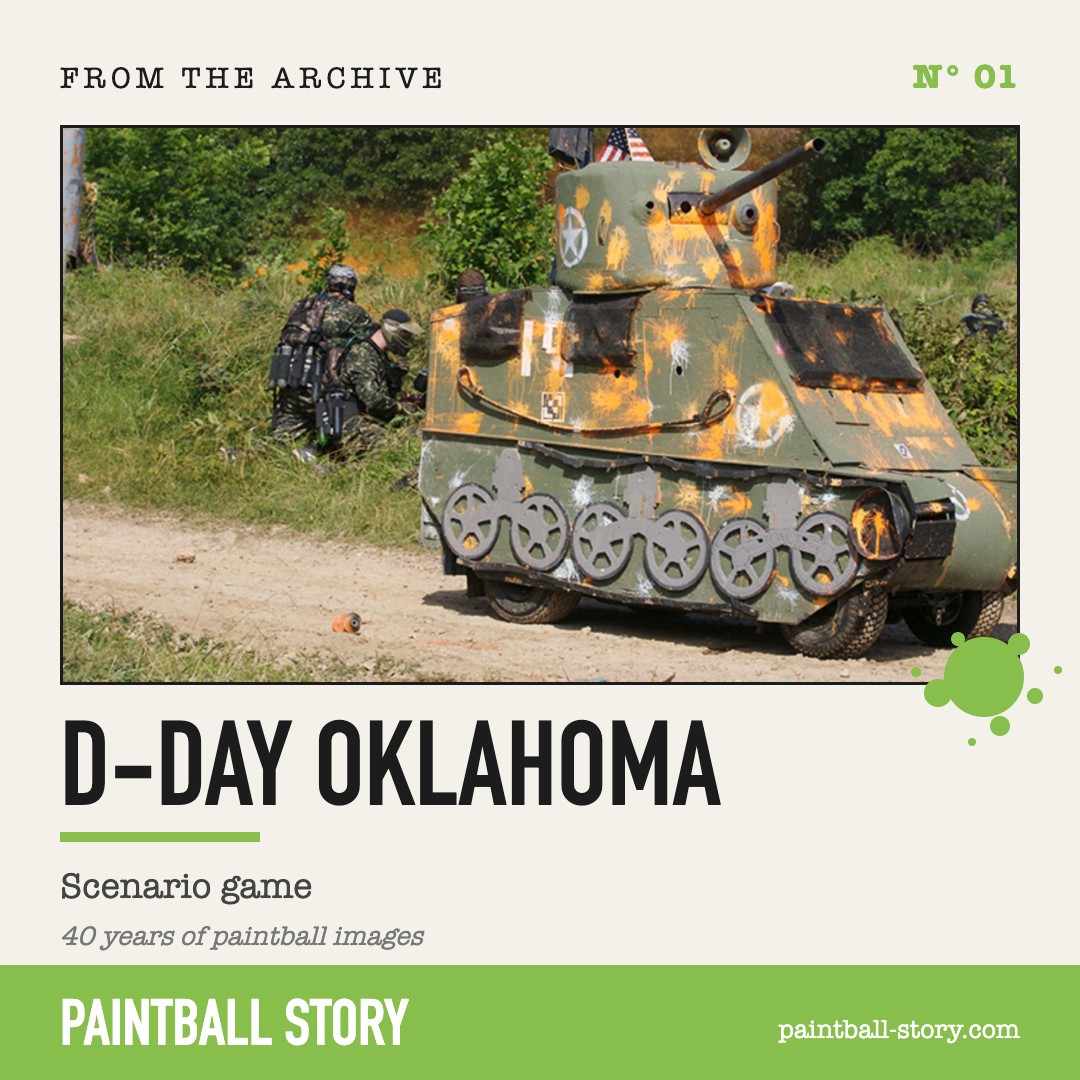
D-Day Oklahoma. Tanks, trenches and hundreds of players in the same field — one of the big scenario games, photographed from the staging area to the last push.
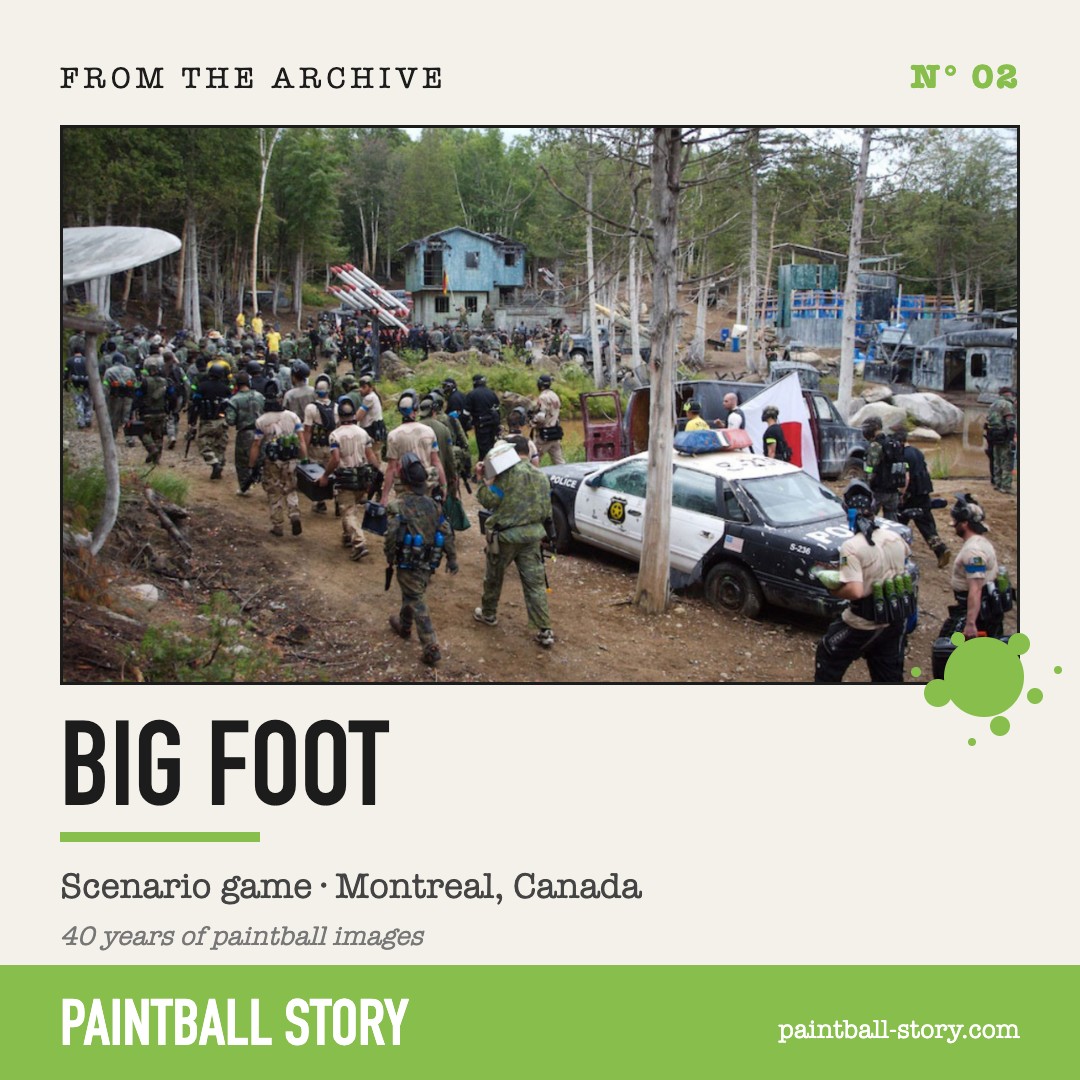
Big Foot, Montreal, Canada. A whole village built for one game, police cars included, and a column of players walking in at the start of the day.
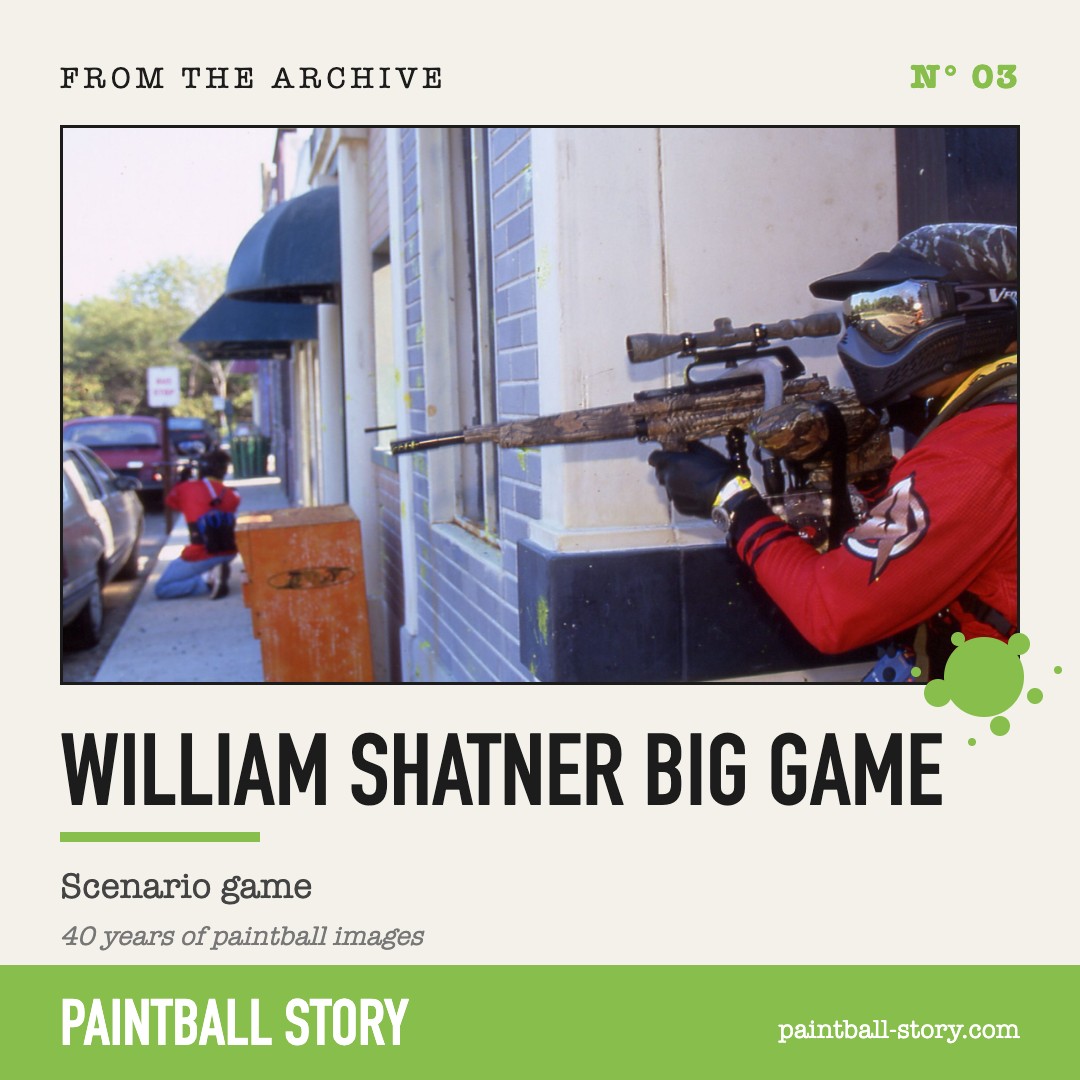
William Shatner hosted his own paintball big game, and the whole event was photographed: the street fighting, the pits, the crowd and the man himself.
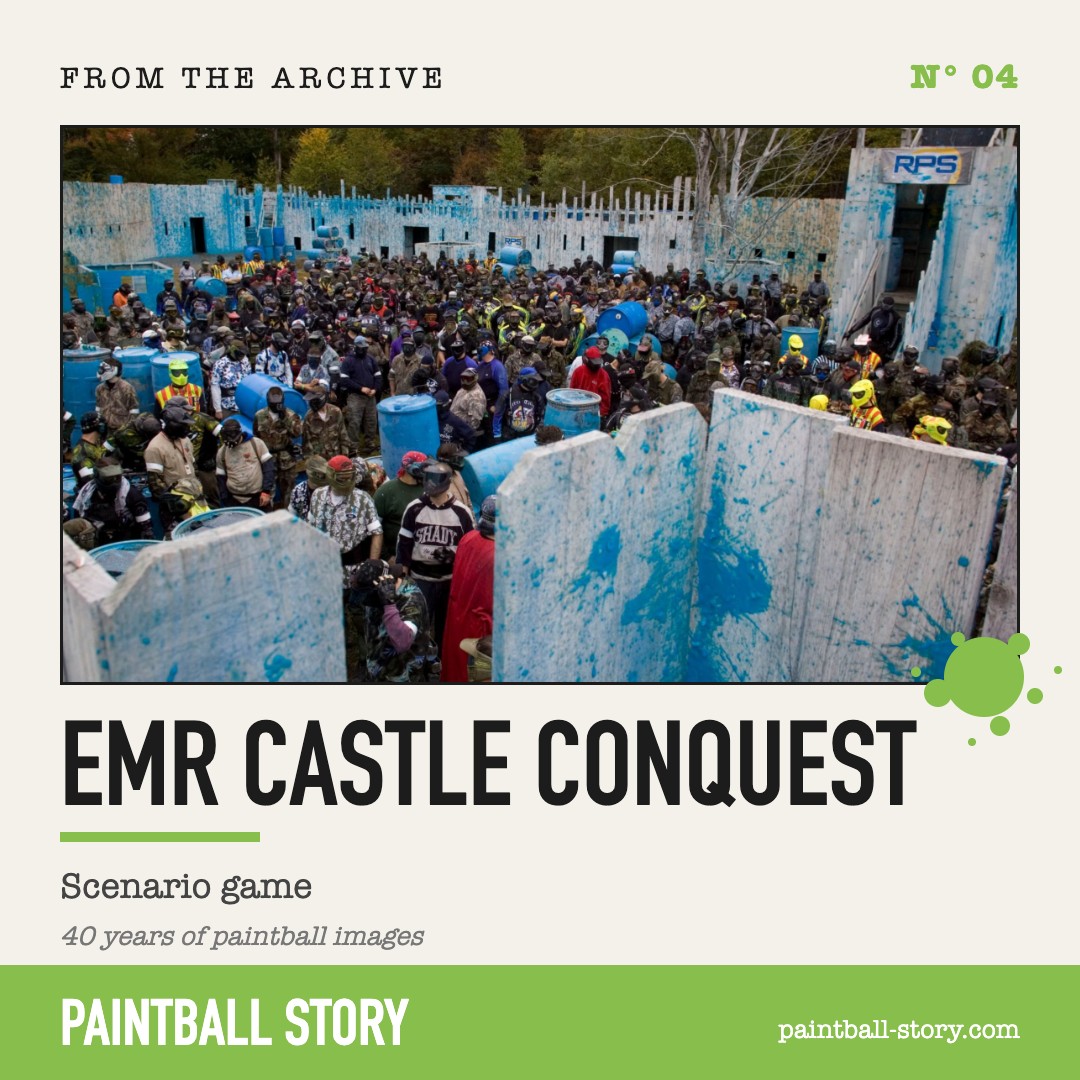
EMR Castle Conquest. A concrete castle with paint on every wall, and a crowd of players stacked up at the gate waiting for it to open.
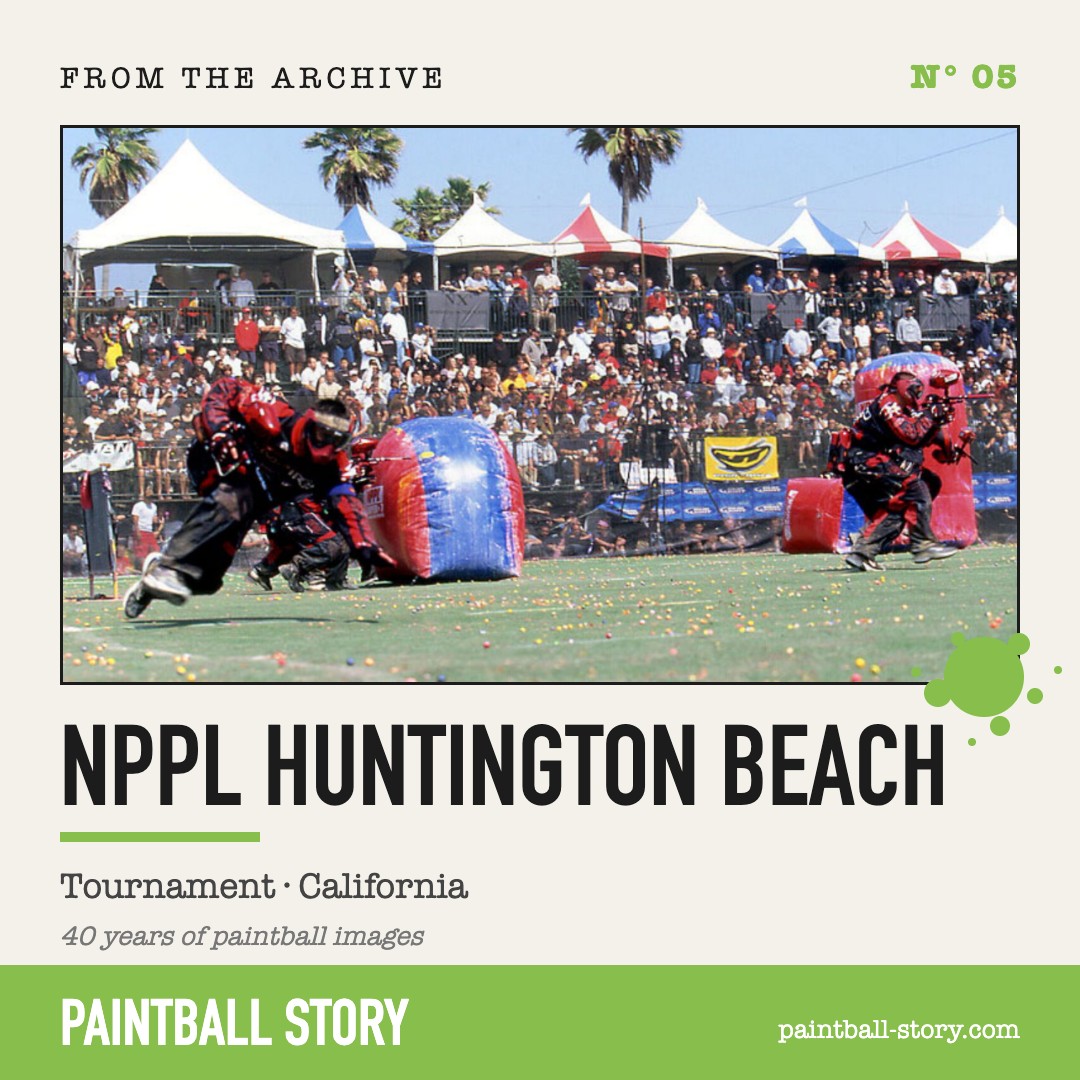
NPPL Huntington Beach, California. Palm trees, white vendor tents, and a grandstand packed to the back row around a field laid out on the grass.
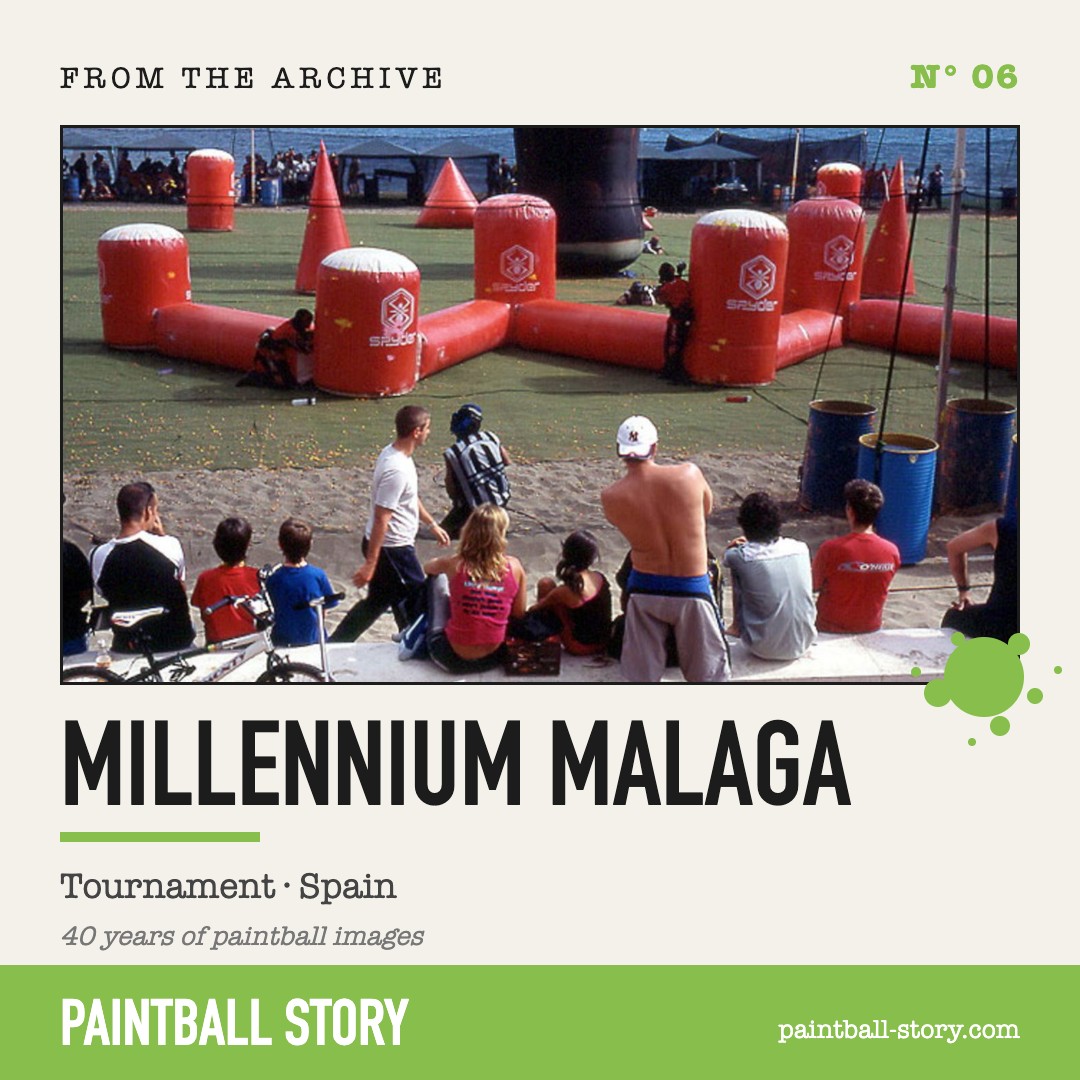
Millennium Malaga, Spain, 2004. The European circuit on the coast: red bunkers set up on the sand, spectators sitting a few steps from the tape, and the Mediterranean right behind the field.
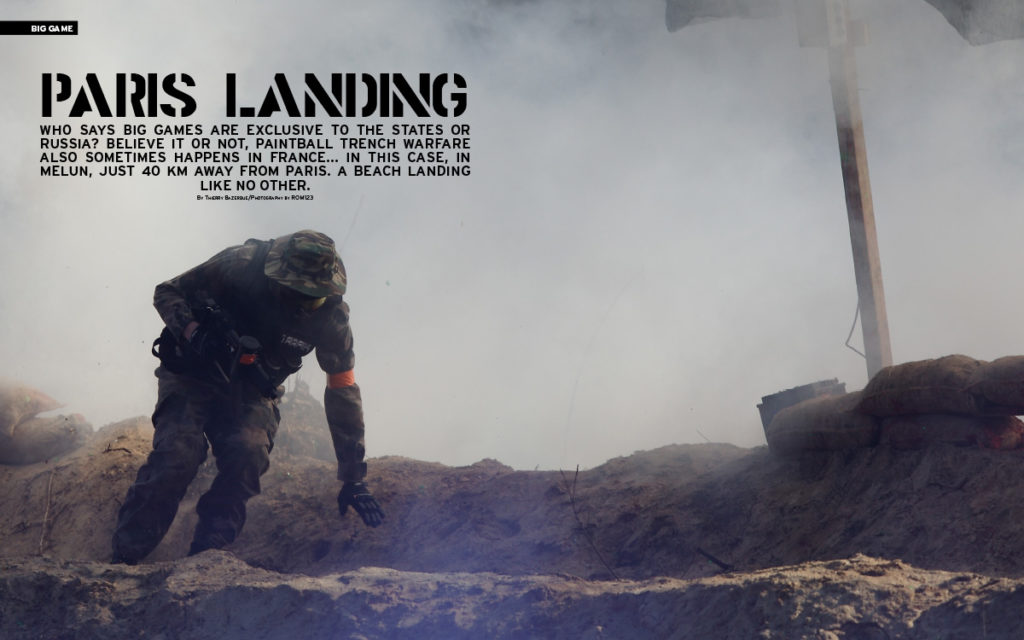
Who says Big Games are exclusive to the States or Russia? Believe it or not, paintball trench warfare also sometimes happens in France… in this case, in Melun, just 40 km away from Paris. A beach landing like no other.
By Thierry Bazerque/Photography by ROM123
The site was called FDP, and those crazy organizers managed to recreate a life-sized landing. For this event, more than 200 players were expected. When we got to the site at 9 AM, about fifty players were already there. Jean-Noël Péché (FDP organizer) had told us about this site and kept us in the loop as it was being built. We were all as excited as 12 year old kids, all trying to imagine what this field was going to be like. There were going to be four landing boats, trenches, bunkers… the game of a lifetime. But as we got out of our cars, we realized how wrong we had been. This site was unreal, so much better than in our wild expectations. On a gentle slope 360 feet long, 4 boats were set down on the sand, facing a well-protected beach, including 3 concrete bunkers overlooking the landscape.
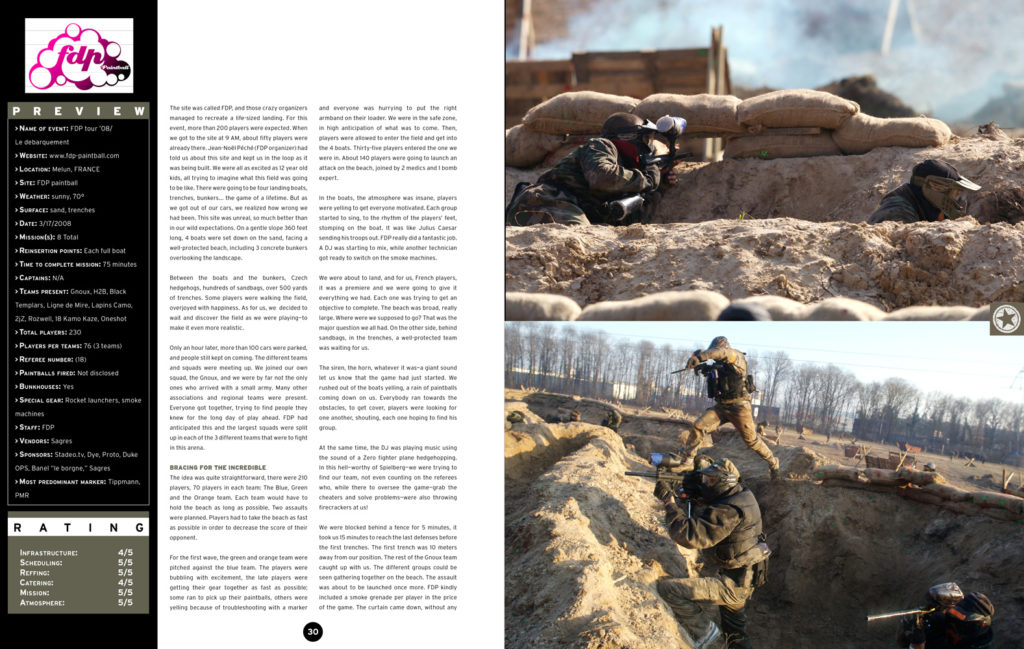
Between the boats and the bunkers, Czech hedgehogs, hundreds of sandbags, over 500 yards of trenches. Some players were walking the field, overjoyed with happiness. As for us, we decided to wait and discover the field as we were playing—to make it even more realistic.


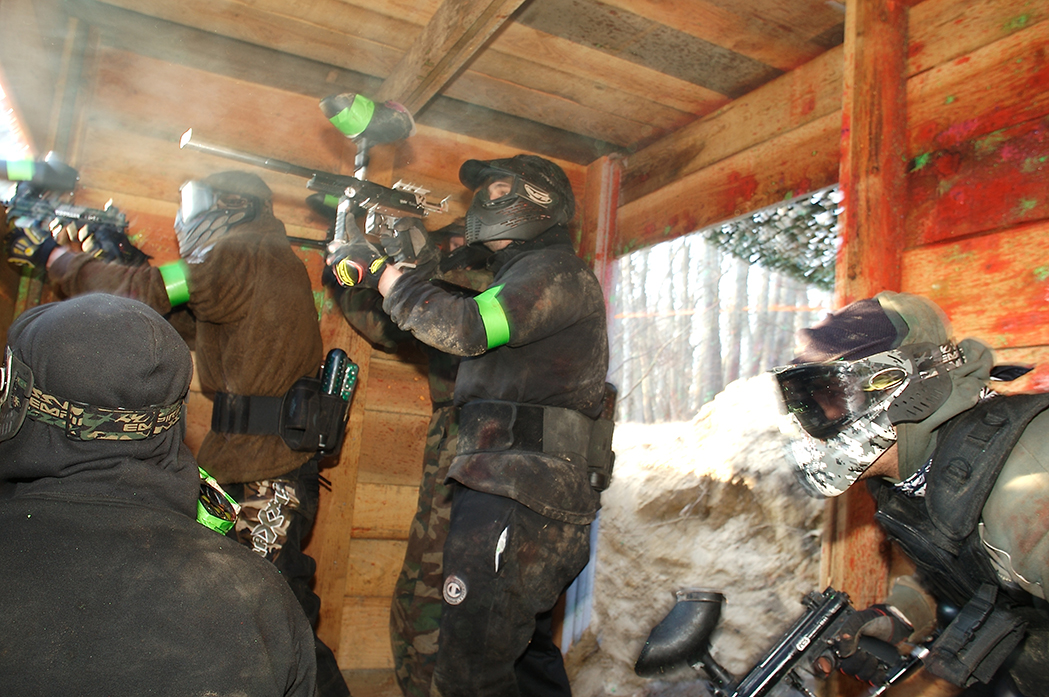


Only an hour later, more than 100 cars were parked, and people still kept on coming. The different teams and squads were meeting up. We joined our own squad, the Gnoux, and we were by far not the only ones who arrived with a small army. Many other associations and regional teams were present. Everyone got together, trying to find people they knew for the long day of play ahead. FDP had anticipated this and the largest squads were split up in each of the 3 different teams that were to fight in this arena.
BRACING FOR THE INCREDIBLE
The idea was quite straightforward, there were 210 players, 70 players in each team: The Blue, Green and the Orange team. Each team would have to hold the beach as long as possible. Two assaults were planned. Players had to take the beach as fast as possible in order to decrease the score of their opponent.
For the first wave, the green and orange team were pitched against the blue team. The players were bubbling with excitement, the late players were getting their gear together as fast as possible; some ran to pick up their paintballs, others were yelling because of troubleshooting with a marker and everyone was hurrying to put the right armband on their loader. We were in the safe zone, in high anticipation of what was to come. Then, players were allowed to enter the field and get into the 4 boats. Thirty-five players entered the one we were in. About 140 players were going to launch an attack on the beach, joined by 2 medics and 1 bomb expert.
In the boats, the atmosphere was insane, players were yelling to get everyone motivated. Each group started to sing, to the rhythm of the players’ feet, stomping on the boat. It was like Julius Caesar sending his troops out. FDP really did a fantastic job. A DJ was starting to mix, while another technician got ready to switch on the smoke machines.
We were about to land, and for us, French players, it was a premiere and we were going to give it everything we had. Each one was trying to get an objective to complete. The beach was broad, really large. Where were we supposed to go? That was the major question we all had. On the other side, behind sandbags, in the trenches, a well-protected team was waiting for us.


The siren, the horn, whatever it was—a giant sound let us know that the game had just started. We rushed out of the boats yelling, a rain of paintballs coming down on us. Everybody ran towards the obstacles, to get cover, players were looking for one another, shouting, each one hoping to find his group.
At the same time, the DJ was playing music using the sound of a Zero fighter plane hedgehopping. In this hell—worthy of Spielberg—we were trying to find our team, not even counting on the referees who, while there to oversee the game—grab the cheaters and solve problems—were also throwing firecrackers at us!
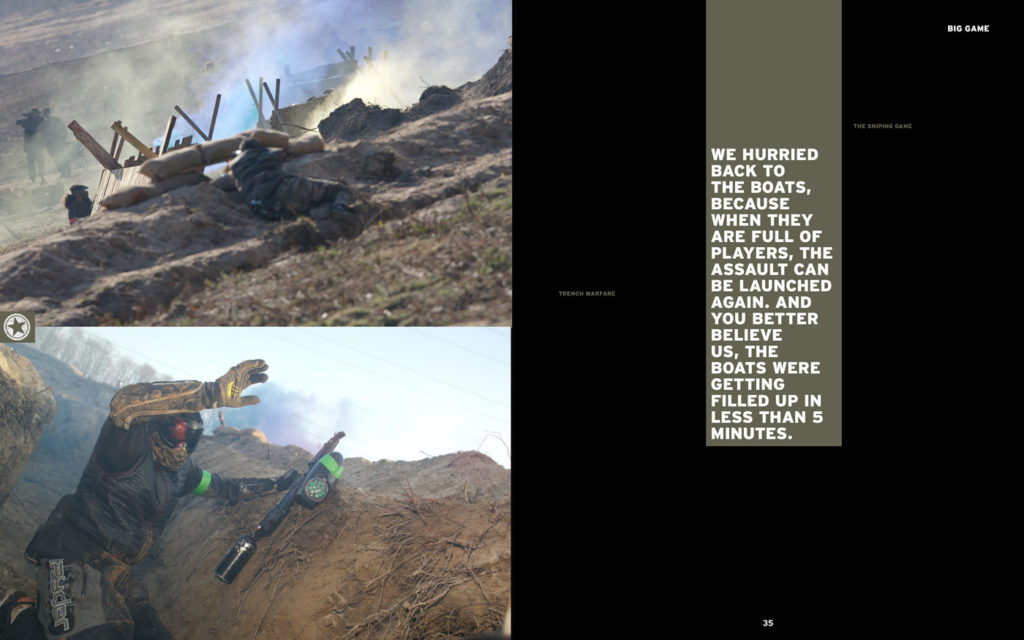
We were blocked behind a fence for 5 minutes, it took us 15 minutes to reach the last defenses before the first trenches. The first trench was 10 meters away from our position. The rest of the Gnoux team caught up with us. The different groups could be seen gathering together on the beach. The assault was about to be launched once more. FDP kindly included a smoke grenade per player in the price of the game. The curtain came down, without any coordination, players threw their smoke grenades to stop the opponents from seeing them. We didn’t go much further than the smoke screen, no sooner had we jumped in the first trench that we got out.We hurried back to the boats, because when they are full of players, the assault can be launched again. And you better believe us, the boats were getting filled up in less than 5 minutes.
Controlling the first trench took more time than expected, 3 assaults. But we rushed back as often as we could and we were never alone. But in the trenches, it was quite another story. Sometimes, the trenches were man-sized, sometimes hardly even 5 feet, and that was considerably stressful. You shouldn’t try to look up at anything, or that’s a hit right between the eyes.
The danger came from everywhere, you had to keep track of what happened before and beside you—in short, playing alone was a quick one way ticket to the safe zone.
TRENCH WARFARE
In the trenches, it was kind of like Verdun, each centimeter taken was characterized by heavy losses. Our opponents controlled the path, but we were gradually fighting up to the bunkers. It took us more than 20 minutes to reach the first bunker. And then the opposing team was pushed back. Once we forced their defenses we were just pushing them away. Victory was ours. The orange team had taken the beach.
But it was midday and the game stopped for the lunch break. Everyone gathered around, talking about the battles just lived and giving their overall feelings about the entirely revamped site. As for what happened to us, two things stood out in the game: the excitement when rushing out of the boats against incoming fire, and the uneasiness of making our way through the trenches.
After this first game, we took the time to recon the field. The bunkers were awesome, not a single nail could be seen out of the buildings, and the trenches, in spite of the violent assault, were still in good shape. Surprisingly, the same thing could be said about the sandbags. The quality of this field was really impressive. Facing the boats, I could imagine what our opponents had seen: 140 warriors running towards their barricaded positions. I couldn’t wait to be part of the defending team to get their experience. Just one hour later, it was time for another attack. The first game let everyone know about the strong and weak sides of the field. Our attack plan was clearly on the left and right flanks. But how could we stand united playing on a field 360 feet wide. You could only hope that a player could see his mate jumping in the first trench. This second game was more fluid than the first one. We were focusing our attention on the flanks, the Squads were playing with smaller teams and even walk-on players, who really enjoyed following us during this assault.
3 PM. The last attack was being prepared. There we were in the trenches to defend our base. This was an intense moment, seeing the attackers getting into the boats, just in front of us. We put down our marker, just to look at the scenery. Players were yelling, we were planning on a defense line where everyone had to take care of his teammate. A mobile group would alternate between the two flanks that had to be protected.
THE SNIPING GAME
To make sure we hit a player that landed, we waited for him to run for about 30 feet. We took our position in our trench and picked them off. There was an eagerness to take the fight to them one last time. The game-on alarm sounded. It was amazing to see them run towards our defenses, shooting anywhere and everywhere. Now we understood what the first defense team must have felt like. We had to stop a huge wave from crushing into our position, and stopping them from reaching our last defense line on the beach before they got into our trenches was our main objective. You constantly have to switch with your teammate, when he is done shooting and has to reload, it is your turn to shoot at the incoming players. There is a 30-second window without covering fire. We tried to stand our ground. We had noticed that during the two other games: fighting back meant a sure loss. This wasn’t going to happen to us. This way, we held the trenches for 20 minutes before the first line was taken. And then we were done. We tried to contain them into the first trench, where it’s much harder to duck down. We held the bunkers another 10 minutes before being flunked out of the beach into the forest and surrendering.
We were really disappointed. Not because we lost, but because it was the last game on this impressive field, worthy of a movie set. About 400 square feet of pure action, 1000 sandbags, 500 meters of trenches, about twenty referees, a DJ, smoke machines, and players who were really fair play. Everything that makes up good scenario paintball in France was there, from great equipment to great weather.


But the party wasn’t over, and this unforgettable day ended with loads of gifts. Dye offered a PMR marker as well as other smaller presents.
For a long time, France has been jealous of the fields and events that take place in the US, or up in Canada’s Bigfoot site, but it seems that Europe is getting its own, realistic scenario paintball site.
The organizers have big plans. Today, they are setting up the FDP TOUR, with 4 events, in different types of facilities. That can only mean good news for European woodsball.
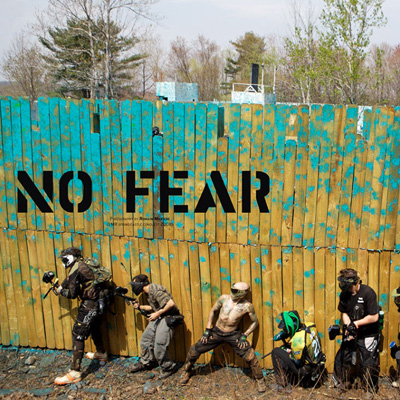

EMR Castle Conquest is one of the most iconic and enduring paintball scenario games in the world. Held at EMR Paintball Park in New Milford, Pennsylvania, this annual event draws paintball enthusiasts from all over to participate in a massive and immersive battle scenario. In this article, we’ll explore the history, gameplay, and excitement of EMR Castle Conquest.
The Boss
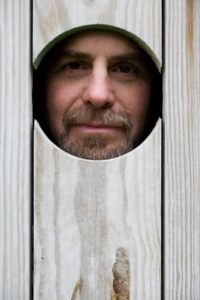
History: EMR Castle Conquest has a rich history dating back to its inception in 1987. It was created by Randy “Sidekick” Smith and originally played at Skirmish USA before moving to EMR Paintball Park. Over the years, it has grown in popularity, becoming a staple event in the paintball community.
Gameplay: The heart of EMR Castle Conquest lies in its unique gameplay. The event typically centers around a large-scale scenario that simulates a historical battle. The primary objective is for one side to capture and control a central castle while the other side defends it. The game often spans an entire weekend and features various missions and objectives, adding depth to the experience.
Immersive Scenarios: What sets EMR Castle Conquest apart is the dedication to creating immersive scenarios. The organizers go to great lengths to design detailed game maps, complete with bunkers, structures, and props that enhance the atmosphere. Participants often come dressed in themed costumes and gear to fully embrace the historical setting.
Massive Player Turnout: One of the hallmarks of EMR Castle Conquest is its massive player turnout. It’s not uncommon for hundreds of players to gather for this event, making it a grand spectacle of paintball warfare. The sheer scale of the game adds to the excitement and camaraderie among participants.
Community and Tradition: EMR Castle Conquest has become a cherished tradition for many paintball players. It’s not just about the gameplay; it’s also about the sense of community and the friendships formed on and off the field. Many players return year after year to relive the experience and introduce newcomers to the world of scenario paintball.
Conclusion: EMR Castle Conquest stands as a testament to the enduring appeal of paintball scenario games. Its rich history, immersive gameplay, and passionate community have made it a must-attend event for paintball enthusiasts. Whether you’re a seasoned scenario player or a newcomer looking to immerse yourself in the world of paintball battles, EMR Castle Conquest offers an unforgettable experience that continues to capture the hearts of players.


1 300 Blue Players
We were massing on the lower hill when the barrage came in-green grenades, blue balls, arcing through the overcast morning and exploding all around us. The ground was slick with mud. Our markers were slick with paint. It was an uphill battle, and they held the high ground…
Text and photography by James Dawson
…and the Castle-Castle Aaarrgh, an acre and a half of two-story ramparts, three-story towers, a courtyard littered with bunkers, and enclosed walls alive with players. The outer walls bristled with marker barrels, like hair standing up on the back of your neck. Players popped up hither and yon, bouncing over the ramparts and past the open shooting ports like human whack-a-mole with paintballs…only we couldn’t whack the moles-they whacked us.
There is a good reason that few great battles have ever been won uphill, and it has everything to do with the angles. Paintball is a game of angles, more so than pool or chess, or at least it hurts more when you botch an angle in paintball. With paint coming down, it can go just a little bit farther-its drop corresponds with the curvature of the land, and so bleeds less energy and travels farther than ours as we shot uphill. Our balls had to gain on the Castle, and gain altitude, shooting the hypotenuse of the triangle rather than a flat angle; and the hypotenuse is always longer than the base. The balls broke on the wall, and broke on the ramparts, and bounced off the players.
Occasionally one caught the corner of hard goggles, or expended its energy in a brilliant blue explosion on a hopper; but mostly our balls landed low and rumbled the wood harmlessly.
Uphill battles-that’s an art. And that’s why players come here, to EMR Paintball in New Milford, PA, every year: to attack, or defend, the hilly terrain and this amazing castle.
In an hour’s worth of reinsertions we were to the wall. Occasionally a marker burst out from between ramparts and pointed down at us, but at such close range we made quick work of them-quick work of their hands and hoppers and markers, turning each a slimy blue.
They didn’t repeat that mistake too often.
The defenders knew what they were doing; so did we, and the odds were stacked in our favor. Yet wave after wave was repelled from the 11:00 starting horn clear through our eventual emplacement right against their walls. Pub Crawling held Wall 2, the one we pushed against up this hill, and laid on their triggers like their very lives depended on it-which they didn’t, of course, but the effect was the same. Two Pub Crawling players manned each window, with a strong deployment on the ramparts above. By shooting out of both sides of the windows and working angles from the ramparts, they had lanes of fire that protected the hillcrest for far longer than anyone expected.
But it fell, in time; then it was a battle at their gate.
Enemy at the Gate
Castle Aaarrgh’s walls are hollow, with protected corridors all through them. Where the first-floor wall breaks for a gateway, the corridor stops with a doorway and resumes on the other side-making natural defensive positions for working side angles within the gateway itself. Players stacked two and three deep in these doorways, shooting over each other’s shoulders and taking their turns at the front when one got dropped.
Penetrating their lanes of fire is tough; but they made it even harder. There had been considerable rain before the event, and many of the barrels used for ancillary fortification were full of rainwater. As part of their strategy, defense-leaders Joint Fury consolidated the rainwater into a number of rather full barrels. These were placed defensively around the doorways, and with the water’s weight and the paint’s slipperiness, proved nearly impossible to move.
Every ten minutes the defenders refreshed their ranks with a new reinsertion, strengthening their manpower behind these immobile fortifications. They brought fresh pods, fresh compressed air tanks, and fresh resolve. Overhead, players had cases of paint-full cases-opened and at the ready, waiting to pour through hoppers and fly out of markers. We had pods in our packs and paintgrenades dangling from gear loops, and did our best to keep up.
The odds for this siege: 4 to 1. 260 players defended ten props inside these walls. 1,040 of us attacked, trying to remove four props by 2:00pm. If we did that, the game would go as long as it has to, until we removed all ten from the courtyard. We were more than an hour into the game before getting to the wall; and the other attackers were in similar straights.


Blue’s Crew
«I tried to lead charges over here a number of times,» Blue-field owner and leader of Blue’s Crew-said, while covered in paint. «Then over there…all different angles. We are just trying to stir up the teams, get them moving.» Backed by principle home team Blue’s Crew, Blue charged down the dirt road bisecting the field and led the push against the turret on the corner of Walls 4 and 1. Unincorporated players and a few cohesive teams followed, flooding the road and filling the air with paint.
They inspired teams on the hill above Wall 4 to open up, and the air turned into a maelstrom of paint and wind. The forward-most players threw paintgrenades at the windows and over the walls. The midrange players trained their muzzles on the parapet and turret. The rearmost players pointed their markers in the general direction of the commotion, their paintballs landing short and repeatedly hitting their own forward players. It was pure paintball insanity-as advertised-and they weren’t even through the walls.
Repelled, Blue and blue-splattered teammates returned to the reinsertion zone.
The attackers have a historically unfair advantage: four to one manpower. Blue explained that this is historic, as most successful military sieges employed at least four attackers for every defender-the manpower overcomes the inherent benefit of being protected by a castle or fort.
But the defenders have their own unfair advantage: reinsertions twice as frequently, and one third as far away, as the attackers. While Blue’s Crew and company have to march down the sloping field to the International Paintball Museum, the defenders only have to dash a few yards across the courtyard or through the walls to reach their own reinsertion zone. And, they rejoin the game every ten minutes, to the attackers’ twenty.
On the whole, these unfair advantages rather fairly balance out.
And on the whole, the attackers usually breach the walls some time shortly after one o’clock. They have a number of props in their control by two o’clock, and the game keeps rolling until, usually around three o’clock, they have the props and physical control of the castle.


But as yet another advance was beaten back-this time from Wall 3-the attackers had only a skeleton crew alongside the walls by one o’clock. And at that, they lacked most of the footholds necessary to advance players from their burgeoning rear echelon to the front, where they were needed.
The defenders held all the cards-and all the props.
Then, fresh with the manpower of another reinsertion, Blue, the Crew, and company swooped down the dirt trail leading away from Wall 3, and charged the longer of two gangplanks up the wall. As the ground sloped down away from the plank the players charged up onto the ramparts, Blue in the lead. He got cut down by withering fire from inside the courtyard, balls coming unimpeded by the last gap-toothed section of old wall.
The player behind him in a red and black shirt got cut down as well, and crouched with Blue out of the way to keep from getting hit like bunkers in the NPPL. Then a shirtless berserker charged up the gangplank, flopped to his belly and crawled-nay, swam-through the blue slime covering the rampart. Though as low as he could go, he was still exposed to sharpshooters below, and took his day’s allotment of lumps and bumps and broken balls all over his bare skin. You can’t wipe the red marks.
And so the clock ticked down steadily towards the end, victory in sight-for the defenders, for once! A mad attacker dashed into the castle, evaded several paint-hurricanes, and grabbed the Royal Platter. He made it back outside, where the prop entered his team’s custody; it constituted exactly one quarter of the props they needed to extend the game beyond 2pm; and at that, the Royal Platter was but ten percent of the props they needed to win the game. Keeping up that rate of capture, the game would have lasted twenty-five hours.
1:55 came and went and ushered in 1:56, every passing moment marked with hundreds of shots from inside, and dwindling fire from outside. A detachment of attackers made it up the second gangplank on Wall 3, near the edge of Wall 4, but were viciously repelled. Stacks of attackers lined up against the walls, yearning for an opportunity to burst into the courtyard, but stood their ground in vain. The barrels were unmovable between the weight, the paint, and the lanes of fire that cut down attackers like wheat chaff.
At 2:00, the game was called-victory for the defenders, the first time in years!
In Defense of Castle Aaarrgh
This was the season for Joint Fury, a team comprised of members of other teams that band together for the common cause: viciously repelling Blue’s Crew. And playing other games too, of course. They were joined in victory this year by Delta Paintball, PA Brew Crew, SF Wicked Wombats, Shadow Company, and others, as well as a few celebrity guests-Dennis Tippmann among them-and random players. By far the ideal role to play, the defenders were decided by splitting the EMR home teams down the middle and inviting certain other players and teams. Once their ranks filled, that was it-waitlist time for everyone else who wanted to defend.
They were met upon the field of honor by Blue’s Crew, Ambush Alpha, Binary Specter, Black Sheep Squad, Fox 4, Ferrmen, Hell’s Henchmen, and many others. In the fall, EMR will host another Castle Conquest-XXIV-to close their Big 4 season for 2007. Then, the defenders and attackers will be switched up, while everything else remains the same.
After Game


The Castle Conquest events are about more than just paintball-they’re about a sense of community between the participants. The weekend warriors go home after the game; some went home even before sides were redrawn and the second Castle Conquest played out that afternoon. But the home teams, their friends, and the stalwarts stay for the evening. That’s when the other side of EMR comes out.
Boneheads, Ferrymen, and company threw their regular joint feast, and invited the neighbors in. Folks brought food of their own to add to something of a potluck feel, and players gathered under tent tops to eat and relive the day’s adventures.
Delta Paintball Team threw a Pirates of the Caribbean theme party, with all sorts of games and fun. Eric Engler and Wedge dressed to the nines, complete with swords and sashes. A good time was had by all, and very, very few players were awake in time for the 10am games on Sunday.
The game attracts the players; the camping and festivities attract the families; and everyone enjoys a full weekend of paintball and camaraderie at Castle Conquest. This is why there have been twenty-three of them, and this is why there will be many, many more.
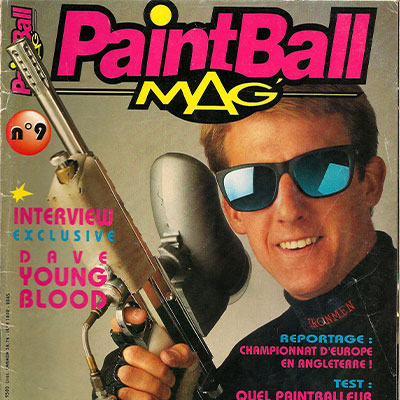
ARTICLE IN PROGRESS.

If you have original publications : send it contact@paintball-story.com
Or ship it to :
ATOMIK PAINTBALL
14 Rue du Petit Albi
95800 CERGY
FRANCE
Tel : +33134220015
THE PAINTBALL BOOKS


INTERNATIONAL PAINTBALL PRESS


FRENCH PAINTBALL MAGAZIN



A Visual Story of Unique Paintball Guns:
Paintball is a sport celebrated for its diversity, not only in gameplay but also in the array of paintball markers available to players. While sleek, modern markers dominate the scene, there exists a fascinating world of paintball guns with quirky, distinctive looks that have captured the imagination of enthusiasts. In this visual journey, we’ll explore some of the most unique paintball markers from the likes of Carter Machine, ZAP, Brass Eagle, and Indian Creek, each with its own peculiar charm.
Carter Machine: The Art of Simplicity
Carter Machine has earned a reputation for producing paintball markers with an almost artistic simplicity. The Carter Buzzard, for example, is a prime example of this approach. With its exposed bolt and minimalist design, it embraces a stripped-down aesthetic that stands in stark contrast to the bulkier markers of its time. Carter Machine markers are a testament to the notion that beauty often lies in the purity of function.
ZAP: Embracing Sci-Fi Aesthetics
ZAP paintball guns take inspiration from science fiction and futuristic designs. These markers often feature sleek, streamlined bodies, and unusual shapes that wouldn’t look out of place in a sci-fi movie. The ZAP ZXS-400 is a prime example, with its striking resemblance to a laser blaster from a galaxy far, far away. ZAP markers evoke a sense of otherworldly adventure on the paintball field.
Brass Eagle: The Charm of Retro, The boss of Design
Brass Eagle has left an indelible mark on paintball history with its unique approach to marker design. The Brass Eagle Rainmaker, for instance, boasts a brass body, giving it a vintage, steampunk-like appearance. These markers harken back to the early days of paintball, reminding players of the sport’s humble beginnings while embracing a distinctive, retro charm.
Indian Creek: Engineering Marvels
Indian Creek markers are known for their intricate and innovative designs. The Indian Creek Designs (ICD) Desert Fox, for instance, features a futuristic, almost robotic appearance with a distinctive angular frame. These markers showcase a fusion of engineering prowess and a desire to push the boundaries of marker aesthetics.
In the world of paintball, markers are not just tools; they are expressions of creativity and innovation. Brands like Carter Machine, ZAP, Brass Eagle, and Indian Creek have taken unique and sometimes unconventional approaches to marker design, giving birth to paintball guns that are not only functional but visually captivating.
Whether you’re drawn to the simplicity of Carter Machine, the sci-fi allure of ZAP, the retro charm of Brass Eagle, or the engineering marvels of Indian Creek, these unique markers remind us that paintball is a sport where individuality and creativity can shine even through the barrels of the quirkiest paintball guns. These markers are a testament to the diverse and colorful world of paintball, where every player can find a marker that speaks to their style and personality.

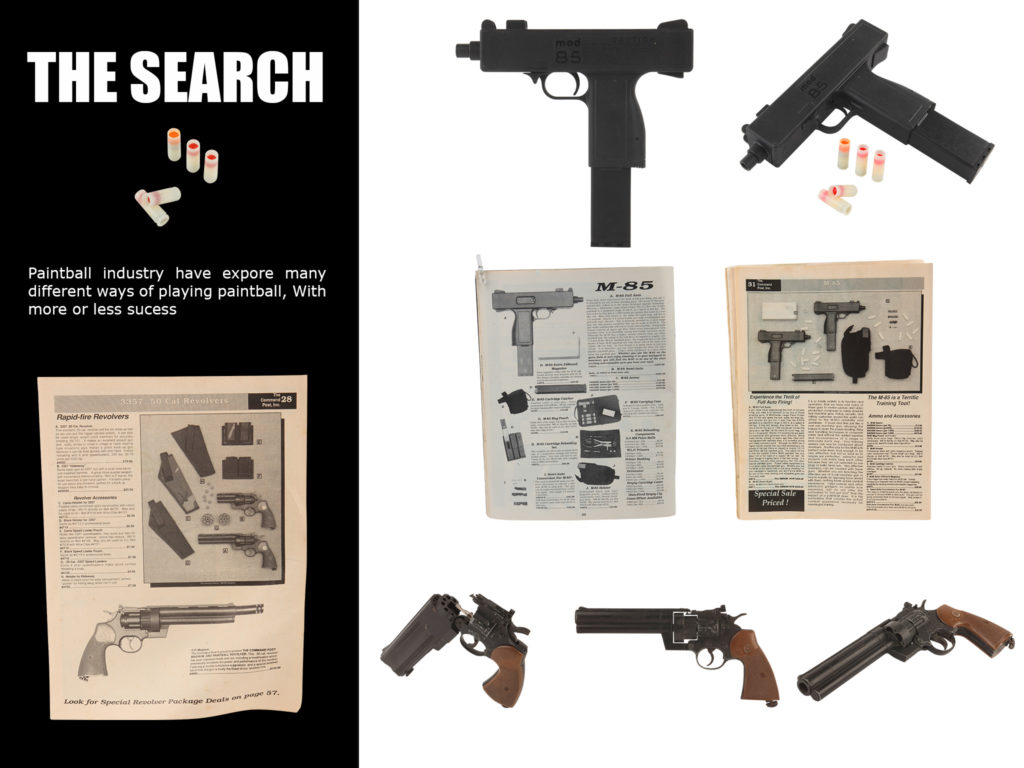



No doubts, the most creative in paintball design


OTHER ATTENDS


Copyright
Romain Manière

paintballer the paintball book
FREE DOWNLOAD